













Table of Content

Businesses no longer compete solely on products, pricing, or marketing. They compete on execution speed as well as expertise.
The ability of organizations to access development talent quickly often determines how fast they can move in the market.
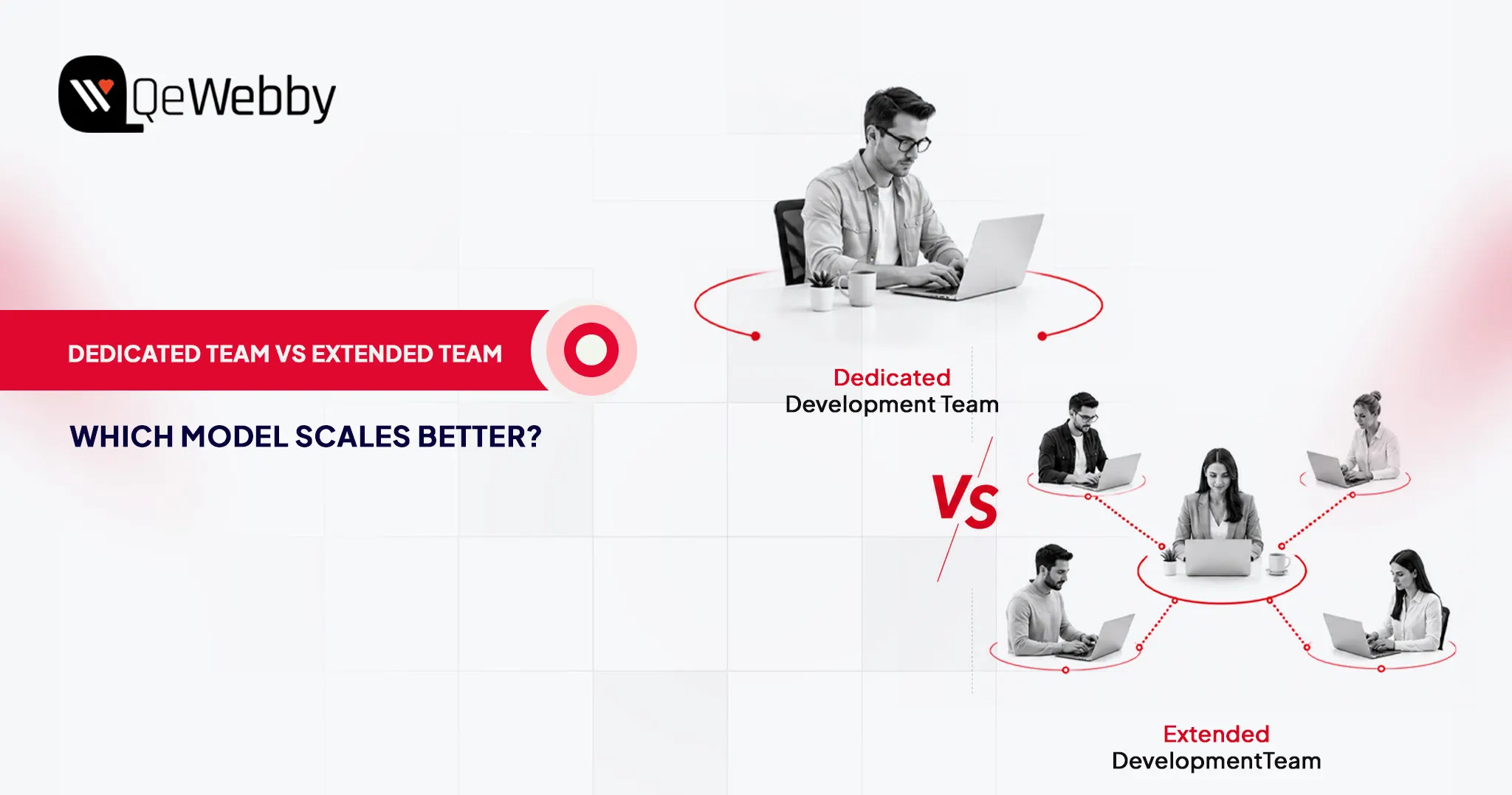
That is why the discussions around dedicated team vs extended team have become one of the most common hiring topics among startups, agencies, and enterprise organizations in 2026.
Traditional and manual hiring cycles are getting slower and more costly. And companies need flexibility, specialized expertise, and predictable delivery without carrying the overhead of permanent recruitment.
As a result, organizations are increasingly turning toward the dedicated team model and extended team model to access experienced and skilled talent.
According to Deloitte’s Global Outsourcing Survey 2024, 80% of executives plan to maintain or increase their investment in third-party outsourcing, highlighting the growing reliance on external development partners.
What Is a Dedicated Team?
A dedicated team is a fully allocated group of professionals assigned exclusively to your business for an agreed period of time.
Unlike freelancers who juggle multiple clients or consultants who engage intermittently, a dedicated team operates as an extension of your organization with long-term commitment and strategic alignment.
The team works only on your projects, follows your priorities, attends your meetings, and becomes deeply familiar with your business objectives.
How the Dedicated Team Model Works?
The dedicated team model functions much like building your own remote development department without handling recruitment, HR management, infrastructure, and employee administration.
A technology partner recruits, manages, and retains the talent while you retain strategic control over priorities and deliverables.
Typically, the engagement process follows these stages:
- Requirements discovery
- Team composition planning
- Resource allocation
- Onboarding
- Sprint planning
- Ongoing delivery cycles
What is the typical team structure for the Dedicated Team Model?
Project Manager
The project manager acts as the coordination hub between stakeholders and technical teams.
Responsibilities include:
- Sprint planning
- Resource allocation
- Risk management
- Delivery tracking
- Stakeholder communication
Developers
Developers form the core of the delivery team.
Depending on project requirements, the team may include:
- Frontend developers
- Backend developers
- Full-stack developers
- WordPress developers
- Mobile developers
- API specialists
Businesses seeking ongoing WordPress development often choose to Hire Dedicated WordPress Team resources to maintain continuous website improvements, plugin development, performance optimization, and security enhancements.
QA Engineers
Quality assurance specialists ensure stable releases through:
- Manual testing
- Automated testing
- Regression testing
- Performance testing
- User acceptance support
UI/UX Designers
Design professionals support:
- User research
- Wireframing
- Prototyping
- User experience optimization
- Interface design
DevOps Engineers
DevOps professionals manage:
- CI/CD pipelines
- Infrastructure automation
- Cloud deployment
- Security monitoring
- Performance optimization
Best Use Cases for a Dedicated Team
The dedicated approach is not ideal for every project. However, it performs exceptionally well in specific scenarios.
Long-Term Product Development
Products that require continuous enhancement benefit from dedicated resources because knowledge accumulates over time.
Instead of repeatedly onboarding new contributors, the same team develops deep familiarity with the product architecture and business logic.
This often leads to faster releases and fewer defects.
Agency Partnerships
Digital agencies frequently use dedicated teams to expand service capacity without increasing internal hiring overhead.
Many agencies leverage a white-label WordPress development team to handle client projects behind the scenes while maintaining their own branding and client relationships.
This approach creates predictable delivery capacity while protecting profit margins.
Ongoing WordPress Development
Businesses relying heavily on WordPress often require:
- Feature enhancements
- Security updates
- Plugin customization
- Performance improvements
- Technical support
What Is an Extended Team?
An extended team is a staffing model where external specialists are added to your existing workforce to fill skill gaps, increase capacity, or accelerate delivery timelines.
Instead of operating as a separate unit, the external professionals become part of your internal team structure.
Think of the extended team model as augmenting your current workforce rather than replacing it.
This approach allows organizations to scale capabilities quickly while maintaining control over management, processes, and strategic direction.
As talent shortages continue to affect global hiring markets, the extended development team approach has become one of the fastest ways to access specialized expertise without lengthy recruitment cycles.
How does the Extended Team Model work?
In the extended team model, external resources report directly into your internal workflows.
Your project managers, product owners, or engineering leaders remain responsible for planning, prioritization, and execution.
The external team members simply become additional contributors.
For example:
A company with five in-house developers may add:
- Two WordPress specialists
- One DevOps engineer
- One QA automation engineer
The external professionals work alongside internal staff while following the same sprint schedules, communication channels, and delivery processes. This creates a seamless operational environment with minimal disruption.
Typical Team Composition for Extended Team
- Software developers
- WordPress developers
- QA engineers
- UX designers
- DevOps engineers
- Cloud architects
- Security specialists
- Data engineers
- AI specialists
Best Use Cases for an Extended Team
Internal Team Augmentation
Specialized Skill Gaps
Many projects require expertise that does not justify a full-time hire.
Examples include:
- Enterprise WordPress architecture
- Cloud migration
- DevOps automation
- Security compliance
- Performance engineering
Short-to-Medium Duration Projects
Projects lasting several months often fit naturally within an extended team engagement.
Examples include:
- Website redesigns
- Platform migrations
- Product launches
- Application modernization initiatives
Freelancer vs Extended Team vs Dedicated Team
Understanding the differences helps avoid costly hiring mistakes and project disruptions.
| Factor | Freelancer | Extended Team | Dedicated Team |
|---|---|---|---|
| Ownership | An individual contributor works independently | External specialists integrate into your internal team | Fully allocated team working exclusively for your business |
| Reliability | Varies by individual availability | High reliability with team support | Very high reliability with dedicated resource allocation |
| Availability | Shared across multiple clients | Dedicated working hours aligned with project needs | Full-time commitment to your projects |
| Management Responsibility | Managed directly by the client | Managed by the client's internal leadership | Shared or provider-managed, depending on engagement |
| Team Structure | Usually one person | Selected specialists added to the existing team | Complete team, including developers, QA, designers, and project management |
| Scalability | Limited | High | Very high |
| Speed of Hiring | Fast | Fast | Fast to moderate, depending on team size |
| QA Support | Usually unavailable | Available when required | Typically included |
| Backup Resources | Rarely available | Available | Available |
| Knowledge Retention | Low | Moderate | High |
| Cost Structure | Hourly or project-based | Hourly or resource-based | Monthly team allocation |
| Typical Pricing | $20-$100/hr | $30-$120/hr | $4,000-$25,000+/month |
| Best Project Duration | Short-term | Short-to-medium term | Long-term |
| Agile & Scrum Alignment | Limited | Strong | Excellent |
| Specialized Skill Access | Moderate | High | High |
| Internal Team Required | No | Yes | Not necessarily |
| Long-Term Product Development | Not ideal | Suitable | Ideal |
| Development | |||
| Operational Control | Moderate | High | High |
| Best For | Small one-off tasks, bug fixes, short projects | Team augmentation, specialized expertise, temporary scaling | Long-term products, agency growth, ongoing development, and strategic initiatives |
When a Freelancer Makes Sense?
Freelancers work best when:
- The scope is clearly defined
- Deliverables are limited
- Specialized expertise is required temporarily
- Budget constraints are significant
Freelancers are generally not ideal for mission-critical systems or long-term product ownership.
Knowledge retention becomes a challenge once the engagement ends.
When an Extended Team Makes Sense?
This model gives organizations flexibility without requiring long-term commitments.
Many scaling SaaS companies adopt an extended development team approach before transitioning toward dedicated teams.
- Have experienced project managers
- Need temporary capacity increases
- Require niche technical expertise
- Want to accelerate delivery timelines
- Need specialized WordPress developers
The extended team model works exceptionally well when organizations already possess internal leadership and development capabilities.
An extended team is often the right choice when you:
When a Dedicated Team Makes Sense?
The dedicated team model becomes increasingly attractive as business complexity grows.
Choose a dedicated team when:
- Product development is ongoing
- Multiple projects run simultaneously
- Long-term scalability is required
- Knowledge retention matters
- Consistent delivery capacity is critical
This model is especially popular among digital agencies.
A dedicated team can function as an internal production department while remaining externally managed.
Many agencies combine Agency Partnership Services with dedicated development resources to expand service capacity while maintaining brand ownership and client relationships.
Typical Cost Comparison In 2026: Dedicated Team Vs Extended Team
| Model | Typical Monthly Cost | Typical Hourly Cost |
|---|---|---|
| Freelancer | N/A | $20-$100/hr |
| Extended Team | Variable | $30-$120/hr |
| Dedicated Team | $4,000-$25,000+/month | Lower blended rate |
At first glance, freelancers often appear to be the least expensive option.
However, hourly pricing rarely tells the full story.
A freelancer charging $40 per hour may require significantly more management, communication, documentation, and rework compared to a structured team operating under established Agile Development processes.
Similarly, an extended team may appear more affordable than a dedicated team because you’re only paying for specific specialists.
But as resource requirements increase, dedicated teams often become more cost-efficient due to predictable allocation and reduced administrative overhead.
What Affects Pricing?
Geography
Location remains one of the largest pricing variables.
Average development costs vary significantly by region.
Many organizations build an offshore development team to reduce costs while maintaining quality standards.
Countries such as India, Poland, Ukraine, and the Philippines continue to attract businesses seeking experienced engineering talent with competitive pricing.
Skill Level
Senior architects, DevOps engineers, AI specialists, and enterprise consultants command significantly higher rates than mid-level developers.
The more specialized the skill set, the higher the investment required.
Team Size
A two-person team and a ten-person team naturally produce very different cost structures.
Team composition also matters.
For example:
- 4 Developers
- 1 QA Engineer
- 1 Project Manager
- 3 Senior Architects
- 2 DevOps Engineers
- 1 Security Consultant
Project Complexity
Projects involving integrations, enterprise workflows, compliance requirements, or high-availability infrastructure typically require more experienced resources.
As complexity increases, pricing follows.
Contract Duration
Longer engagements generally reduce effective hourly costs.
Technology partners can allocate resources more efficiently when engagements extend beyond six months.
This is one reason many organizations adopting the dedicated team model achieve better long-term cost efficiency than businesses constantly cycling through short-term contractors.
Is a Dedicated Team More Expensive Than an Extended Team?
Not necessarily.
A dedicated team usually requires a larger monthly commitment because resources are allocated exclusively to your organization.
However, the overall cost per deliverable often decreases over time.
Dedicated teams provide:
- Faster onboarding
- Better knowledge retention
- Lower turnover impact
- Greater delivery consistency
- Reduced management overhead
An extended team may initially cost less because you’re adding only the resources you need.
But as projects grow in scope and complexity, coordination costs can increase.
For companies with a long-term roadmap, a dedicated team frequently becomes the more economical option despite the larger monthly investment.
The decision should be based on business objectives, not simply hourly rates.
Which Model Should You Choose?
After comparing costs, management responsibilities, and scalability, the next question is obvious:
Which hiring model is right for your business?
The answer depends less on budget and more on where your organization is today, and where you plan to be in the next 12 to 24 months.
Many companies make the mistake of choosing the cheapest option available. High-performing businesses choose the model that aligns with their growth trajectory.
Use the framework below to guide your decision.
Use a Freelancer If:
- You have a small one-time project
- The scope is clearly defined
- The budget is extremely limited
- You don't need long-term support
- Internal resources can manage the work
Freelancers offer flexibility but introduce dependency risks. If that individual becomes unavailable, knowledge transfer and continuity can become major challenges.
Choose an Extended Team If:
- You already have an internal team
- You need specialized expertise
- Hiring full-time employees isn't practical
- You need temporary capacity increases
- Your roadmap fluctuates throughout the year
Choose a Dedicated Team If:
- You have multiple concurrent projects
- Development is ongoing
- You need a predictable delivery capacity
- Product knowledge retention is important
- You want long-term cost efficiency
- You're scaling agency operations
A dedicated team model creates a stable development environment where resources remain aligned with your business goals over time.
Organizations investing heavily in digital transformation, SaaS development, and ongoing WordPress Development Services often see the highest ROI from dedicated teams because they eliminate many of the inefficiencies associated with frequent resource changes.
Pros and Cons of Each Hiring Model
Dedicated Team Pros
- Exclusive resource allocation
- Strong product ownership
- Predictable delivery capacity
- Better knowledge retention
- Lower long-term operational risk
- Easier scaling for ongoing projects
- Often more cost-efficient for long-term development
Dedicated Team Cons
- Higher monthly commitment
- Less suitable for very short projects
- Requires strategic planning to maximize utilization
Extended Team Pros
- Flexible scaling
- Faster access to specialized expertise
- Lower commitment than dedicated teams
- Strong integration with internal teams
- Ideal for temporary capacity expansion
Extended Team Cons
- Requires internal management capabilities
- Knowledge may remain distributed across teams
- It can become harder to coordinate as team size grows
Freelancer Pros
- Lowest initial investment
- Flexible engagement terms
- Useful for specialized short-term tasks
- Quick hiring process
Freelancer Cons
- Limited availability
- No backup resources
- Minimal quality assurance processes
- Higher continuity risk
- Difficult to scale consistently
- Often unsuitable for mission-critical projects
Can You Transition from an Extended Team to a Dedicated Team?
Choosing between an extended team and a dedicated team isn’t always a long-term decision. As businesses grow, product roadmaps expand, and delivery demands increase, the hiring model that worked initially may no longer be the best fit.
The key takeaway from this dedicated team vs extended team comparison is that the right choice depends on your current stage, internal capabilities, and long-term objectives. Rather than focusing solely on cost, evaluate each model based on the value it can deliver to your business.
If you’re exploring the right engagement model for your next project, contact us to discuss how QeWebby can help you scale with dedicated teams, extended teams, and tailored WordPress development solutions.
Ultimately, the best hiring model is the one that enables your team to deliver faster, scale efficiently, and support long-term business success.


Bhargav Dave
Operations and Client Services
Bhargav keeps QeWebby's delivery engine running. With a PRINCE2-certified background in project management and client operations, he ensures every WordPress project, from agency white-label to WooCommerce build, is delivered to scope, on schedule.