













Table of Content

WordPress AI plugins are experiencing a surge in popularity. These plugins generate over 315 million visits annually as businesses rush to automate their optimization efforts.
Here’s what most business owners get wrong. They’re still playing guessing games with their websites. They move buttons around, change colors randomly, and wonder why their conversion rates stay flat. It’s like running a store blindfolded while customers walk out empty-handed.
Innovative businesses take a different approach. They use AI-powered A/B testing tools that analyze every click, scroll, and purchase decision in real-time. These tools don’t just test variations.
They predict winners before the test even ends, automatically optimize for peak performance, and deliver results 300% faster than manual testing. This guide reveals the best AI-powered A/B testing tools for WordPress that turn visitor behavior into conversion gold.
What Are A/B Testing Tools for WordPress?
A/B testing is akin to running a controlled experiment on your website. You take two versions of a page: Version A (your current setup) and Version B (the variation), and see which one performs better with your visitors. It’s simple in concept but incredibly powerful in execution.
A/B testing tools for WordPress make this entire process seamless. These tools automatically split your website traffic, showing different users different versions of a page, and then track how each version performs.
Whether you’re testing headlines, call-to-action buttons, product images, or checkout flows, these tools reveal what actually drives engagement, sign-ups, or sales.
When AI enters the picture, testing becomes even smarter. Modern A/B testing tools utilize machine learning to predict winning variants more quickly, personalize user experiences in real-time, and eliminate guesswork. It’s data-driven optimization on autopilot, which helps your WordPress site continuously evolve and perform at its peak.

Why Using AI-based A/B Testing Tools Is Important?
A/B testing tools help websites perform better by tracking user behavior, optimizing designs, and fine-tuning overall performance. Check below how these tools can make a tangible and significant difference:
1. Understanding User Behaviour
These tools can help uncover hidden patterns by analyzing every visitor’s interactions, which range from clicks and scrolls to session duration and exit points, thereby driving real business results.
It becomes easier for stakeholders to spot the pages that need modifications and improvements in terms of design or functionality to meet visitors’ evolving preferences and expectations.
2. Safeguarding Search Engine Optimization (SEO) Performance
3. Better Conversion Rates
AI-powered A/B testing can help track where users drop off in your sales funnel, allowing you to remove that bottleneck by making necessary improvements.
It is possible to enhance the customer journey and boost conversion rates by testing various elements, including user experience (UX), at every stage of the process.
4. Lower Bounce Rates
Bounce rates indicate how often users visit your website but don’t view the second page and leave it. A high bounce rate indicates that visitors aren’t finding what they are looking for and need on the site.
A/B testing helps identify which content, design, or page encourages users to stay and navigate further on other pages of the site. It can help stakeholders remove the features, design, or content that caused them to leave too soon.
If you run an online store, these WooCommerce conversion strategies pair perfectly with A/B testing to boost sales.
What Are The Different Types Of A/B Testing Tools?
Depending on your goals, traffic volume, and the elements you want to experiment with, the A/B test approach can take on a very different appearance.
Understanding these variations is key to making smarter optimization decisions, especially when evaluating an AI-based testing tools comparison or choosing the right A/B testing tools for WordPress.
1. Standard A/B Testing
This is the classic version, which is simple, direct, and effective. You test two variations of a page or element to see which performs better. For instance, you might change the colour of your “Buy Now” button, adjust a headline, or tweak your hero image.
The goal is to identify which version resonates most with visitors and leads to more clicks, sign-ups, or sales.
2. A/B/n Testing
Sometimes two options just aren’t enough. A/B/n testing allows you to test multiple versions simultaneously of the elements you want to test. This method is most effective for websites with consistent traffic, as it requires sufficient data to compare various variations accurately. It’s like running multiple experiments simultaneously to uncover what users honestly respond to.
3. Multipage Testing
Multipage testing examines the broader picture by evaluating how design and content changes impact a user’s journey across multiple pages. For example, you might test different sequences in your checkout process or see how variations in your product descriptions impact conversions from one page to the next.
4. Multivariate Testing
If you’re ready to go deeper, multivariate testing examines several elements on a page simultaneously. You could test combinations of headlines, button placements, and colour schemes to see which blend performs best. Because this method measures multiple variables at once, it’s ideal for sites with high traffic and complex designs.
Top 10 AI-based A/B Testing Tools For WordPress Sites
Choosing the right testing tool can make or break your website optimization strategy. The market is filled with options, but the key is finding one that uses artificial intelligence to deliver faster insights and more intelligent decisions.
As AI becomes central to modern websites, staying updated with the latest WordPress development trends helps you adopt smarter testing methods.
In this AI-based testing tools comparison, we’ll explore the leading A/B testing tools for WordPress that bring automation, analytics, and AI innovation together to help your website grow smarter every day.
1. VWO (Visual Website Optimizer)
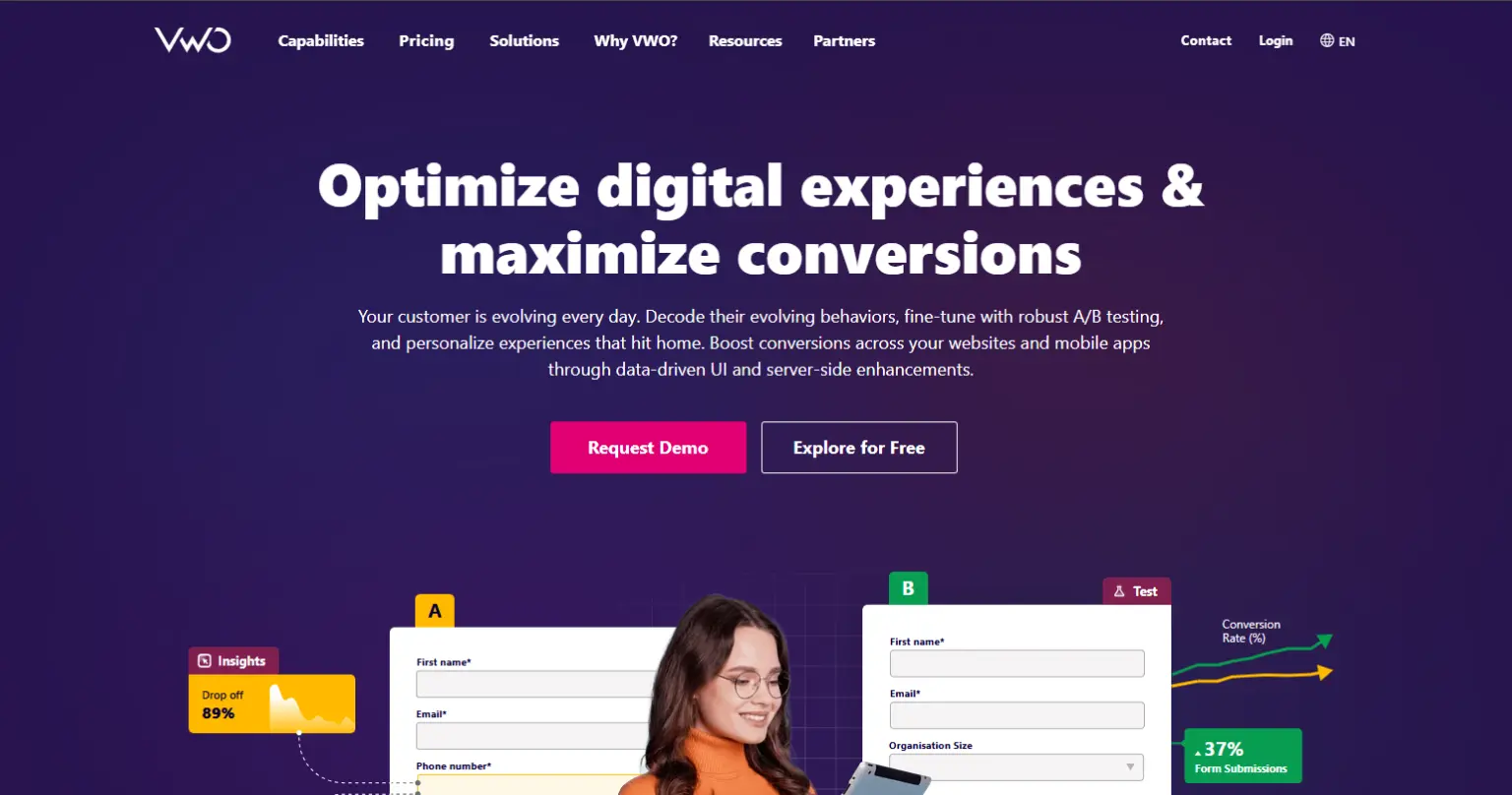
VWO is one of the most comprehensive A/B testing platforms designed for businesses that want both simplicity and depth. It allows you to run experiments, analyze visitor behaviour, and make real-time improvements. Its AI-driven algorithms learn from every interaction to give you faster, more accurate insights.
Key Features and AI Capabilities:
- AI-powered SmartStats for faster and more precise conclusions.
- Heatmaps, clickmaps, and session recordings to visualize user behaviour.
- Predictive analytics that highlight high-performing elements.
- Visual editor for no-code test creation.
- Seamless integration with analytics, CRM, and CMS tools.
Benefits of Using VWO:
- Provides faster and more accurate experiment results.
- Easy for beginners yet robust for professionals.
- Reduces decision fatigue with data-backed insights.
- Enhances conversions with continuous testing.
2. AB Tasty
Key Features and AI Capabilities:
- AI-based predictive targeting and personalization.
- Visual editor for quick test setup.
- Dynamic segmentation to tailor experiences.
- Integrated heatmaps and session replay tools.
- Machine learning recommendations to optimize engagement.
Benefits of Using AB Tasty:
- Delivers tailored experiences across user segments.
- Simplifies complex experiments into easy workflows.
- Helps increase conversions and retention rates.
- Suitable for teams of all technical levels.
3. Kameleoon
Kameleoon is a data-driven experimentation and personalization platform that uses AI to predict conversion intent. It’s ideal for businesses that want to combine testing with deep personalization insights. Kameleoon’s algorithms automatically adapt your content for each visitor to maximize engagement and revenue.
Key Features and AI Capabilities:
- AI-powered predictive analytics and targeting.
- Real-time user intent detection.
- Visual and code-based experiment editors.
- Automated reporting with deep insights.
- Privacy-first, GDPR-compliant platform.
Benefits of Using Kameleoon:
- Improves targeting accuracy with machine learning.
- Adapt experiences based on user behaviour.
- Reduces manual optimization time.
- Works well for enterprise-level traffic.
4. Fibr AI
Fibr AI focuses on intelligent automation and predictive modelling, enabling faster and smarter experimentation. Designed for marketers and developers alike, it minimizes manual setup and uses machine learning to identify winning variations early. This helps you act on insights before competitors do.
Key Features and AI Capabilities:
- AI-powered clustering for data-driven segmentation.
- Automated traffic allocation and balancing.
- Instant performance insights and live monitoring.
- Predictive modelling for conversion optimization.
- Compatible with WordPress and other CMS platforms.
Benefits of Using Fibr AI:
- Speeds up testing cycles significantly.
- Reduces dependency on large data samples.
- Makes optimization easier through automation.
- Perfect for small and mid-sized teams.
5. Optimizely
Key Features and AI Capabilities:
- Machine learning for traffic allocation and result prediction.
- Multivariate, multipage, and server-side testing.
- AI-driven personalization for targeted experiences.
- Advanced analytics with statistical confidence scoring.
- Integrates easily with WordPress and analytics stacks.
Benefits of Using Optimizely:
- Ideal for enterprise-level experimentation.
- Reduces manual monitoring with smart automation.
- Provides actionable insights at scale.
- Drives consistent, data-backed growth.
6. Unbounce
Unbounce is designed for marketers who prioritize landing page performance and conversions. Its AI-driven Smart Traffic feature automatically sends visitors to the best-performing version of your page. Whether you’re testing ad campaigns or product launches, Unbounce makes optimization effortless.
Key Features and AI Capabilities:
- Smart Traffic AI that automatically redirects to the winning variants.
- Drag-and-drop page builder with custom templates.
- AI-generated copy and content suggestions.
- Conversion tracking and analytics dashboard.
- Supports A/B and multivariate testing.
Benefits of Using Unbounce:
- Increases conversions without technical expertise.
- Saves time through automation and pre-built designs.
- Perfect for marketers running paid campaigns.
- Improves ad relevance and ROI instantly.
7. Nelio A/B Testing
Key Features and AI Capabilities:
- AI-driven heatmaps and engagement tracking.
- Test any page element directly in WordPress.
- Automatic identification of winning versions.
- Real-time conversion analytics.
- Lightweight, easy to install, and beginner-friendly.
Benefits of Using Nelio A/B Testing:
- Perfect for WordPress users of all skill levels.
- No external setup or complex coding needed.
- Saves time with automated winner selection.
- Offers high-value insights for small sites.
8. Convertize
Convertize blends behavioural psychology and AI automation to simplify testing. Its unique AutoPilot system dynamically shifts traffic toward the highest-performing version, ensuring continuous improvement with minimal input. It’s great for teams that want hands-free optimization.
Key Features and AI Capabilities:
- AutoPilot AI for automated traffic allocation.
- Pre-built persuasion templates for faster results.
- Smart notifications and dynamic triggers.
- Real-time performance and conversion tracking.
- WordPress integration for easy setup.
Benefits of Using Convertize:
- Reduces manual effort with intelligent automation.
- Boosts engagement using behavioural science.
- Quick to set up, even for non-developers.
- Adapts tests automatically based on visitor data.
9. Instapage
Key Features and AI Capabilities:
- AI-based heatmaps for user journey tracking.
- Dynamic text replacement for audience-specific messaging.
- Drag-and-drop editor for fast design.
- A/B and multivariate testing support.
- Integrations with CRMs and analytics tools.
Benefits of Using Instapage:
- Ideal for PPC and paid campaign optimization.
- Improves ad conversion and quality scores.
- Enhances collaboration between teams.
- Reduces time-to-launch for marketing campaigns.
10. ABtesting.ai
ABtesting.ai utilizes artificial intelligence to automate every aspect of testing, eliminating the need for setup or manual input. It generates variations, runs experiments, and automatically selects winners. It’s perfect for teams that want to optimize without spending hours managing tests.
Key Features and AI Capabilities:
- AI-generated headlines and CTAs.
- Automated experiment creation and tracking.
- Predictive insights to identify top performers early.
- One-click WordPress integration.
- Continuous optimization with self-learning models.
Benefits of Using ABtesting.ai:
- Saves time with end-to-end automation.
- Great for startups and small businesses.
- Continuously improves website performance.
- Requires minimal technical skill to operate.
Free vs Paid A/B Testing for WordPress: When to Upgrade
Use a free tool if: You have under 10,000 monthly visitors. At lower traffic volumes, most tests will never reach statistical significance regardless of the tool — the constraint is data, not the platform.
Upgrade to paid if: You’re running tests on pages that generate revenue. The ROI calculation is simple: if a winning test improves conversion by 10% on a page doing $10,000/month, a $100/month tool pays for itself in 3 days.
Conclusion
AI-powered A/B testing tools enable developers to optimize and analyze site performance and user interaction without compromising SEO. Selecting the most suitable A/B testing platform according to your needs can be confusing because every tool has its strengths and weaknesses.
These thorough and detailed AI-based testing tools can help you make informed decisions that align with your business needs and objectives. If you still have any queries related to your business website, you can contact us to address your query with practical and result-oriented solutions from our team.

Nikhil Makwana
Associate General Manager, Digital Marketing
Nikhil brings 15+ years of digital growth experience to QeWebby, from AEO and GEO to AI-driven marketing automation. He ensures every WordPress engagement is backed by a visibility and performance strategy from day one.
Frequently Asked Questions
#1. How do AI-powered A/B testing tools improve WordPress website performance?
#2. What’s the difference between traditional and AI-based A/B testing?
#3. How often should I run A/B tests on my WordPress website?
#4. Can A/B testing affect SEO rankings?
#5. Do AI A/B testing tools require significant traffic to work effectively?
#6. Does A/B testing slow down my WordPress site?
Most modern tools add less than 50ms to page load when configured correctly. The key is to load the testing script asynchronously and avoid flicker by using server-side testing for above-the-fold changes.
#7. How long should an A/B test run on WordPress?
At minimum, until you reach statistical significance (usually 95% confidence) with at least 100 conversions per variant. For most small WordPress sites, this means 2-4 weeks minimum. Don’t stop early just because one variant is leading.
#8. Can I A/B test with a free WordPress plugin?
Yes. AB Press Optimizer has a functional free tier. Google also offers free experimentation via GA4 + Google Optimize for sites already using Analytics.