













Table of Content

In modern B2B environments, speed, data flow, and seamless API integration determine whether businesses scale or stall. According to Salesforce’s 2025 report, only 27% of enterprise applications in APAC are fully interconnected, leaving most organizations operating in data silos.
As companies embrace innovations such as generative AI, B2B API integrations become increasingly crucial. McKinsey reports that 42% of B2B decision-makers are already using generative AI, or are preparing to use it. But if your systems can’t connect and integrate such innovations seamlessly, your business will lag in an AI-first market.
That’s where API integration for business becomes the real growth driver. APIs aren’t just technical add-ons. B2B APIs help connect your existing systems with CRMs, payment systems, logistics tools, and communication platforms.
The best APIs for B2B integration depend on your business function. CRM APIs like Salesforce and HubSpot unify customer data, payment APIs like Stripe handle secure transactions, communication APIs like Twilio enable real-time messaging, while infrastructure APIs like AWS and Microsoft Graph power scalable, connected enterprise systems. Most modern B2B platforms rely on multiple APIs working together rather than a single solution.
Picking the wrong B2B API costs more than developer time. it stalls launches, breaks pipelines, and creates technical debt that scales with your business. This guide cuts through 100+ options to the 11 APIs that are actually production-ready in 2026: battle-tested, well-documented, and built for business-to-business data flows. Each entry includes a real-world use case, a difficulty rating, and the one thing most guides don’t tell you about integrating it.
Why B2B API Integration Is the Backbone of Modern Business Operations?
B2B API integrations enable seamless, real-time data exchange between systems, automating processes and reducing errors. It also allows businesses to create an agile, efficient, and connected business ecosystem.
Here are some key reasons why you need to invest in B2B API integrations,
- Reduced Silos- B2B API integrations help break down silos across CRM, ERP, and supply chain processes. It offers a unified view of all the data and ensures everyone has access to real-time data.
- Process Automation- Integrating B2B APIs can automate repetitive tasks that take too much time and effort. It also minimizes human error and optimizes outcomes.
- Improved Collaborations- APIs enable direct, secure data sharing with partners, suppliers, and customers. This fosters smoother collaborations, faster approvals, and transparent communication across the value chain.
- Faster Decision-Making- With real-time data flowing across integrated platforms, leaders gain timely and accurate information to make better business decisions, respond quickly to market changes, and capitalize on new opportunities.
- Scalability and Flexibility- APIs make it easy to add or upgrade business systems, launch new products, or scale to new markets without rebuilding core infrastructure.
- Enhanced Customer Experience- By connecting backend and frontend systems, B2B APIs ensure that customers and partners have seamless interactions, prompt support, and efficient order fulfillment.
- Stronger Security & Compliance- APIs enable secure, permission-based data exchange and make it easier to track data flows, thereby supporting better compliance with industry regulations.
Key Criteria for Choosing the Right API for B2B Integration
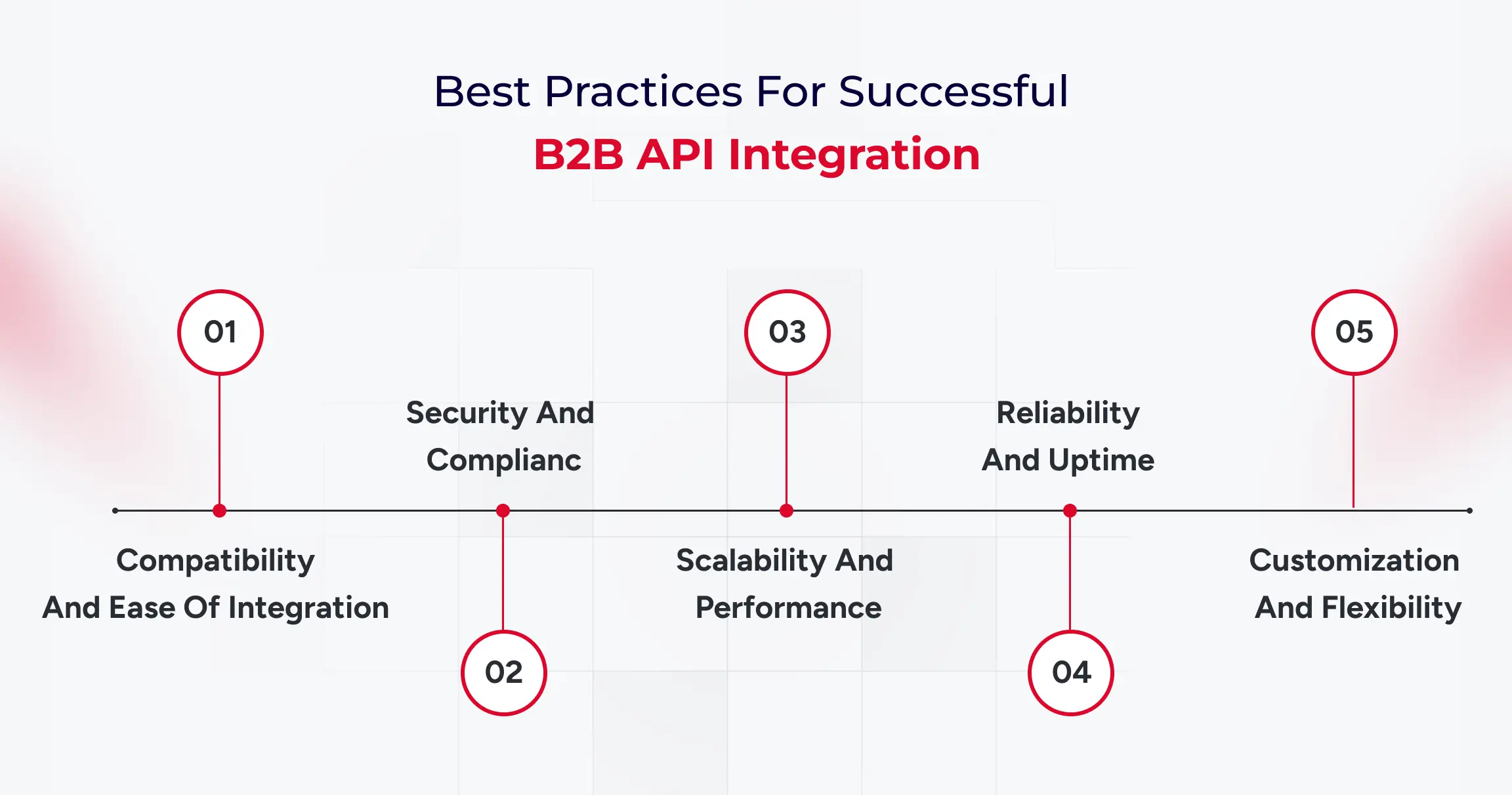
Selecting the best API for your B2B integration project is fundamental to creating a reliable, efficient, and future-ready business operation. Here’s what you should continually evaluate before making your choice:
1. Compatibility and Ease of Integration
Ensure the API works seamlessly with your existing systems (CRM, ERP, supply chain, etc.). Look for well-documented endpoints, SDKs, and support for multiple programming languages to minimize development time and complexity.
2. Security and Compliance
Your chosen API should support secure data transmission and robust authentication protocols (such as OAuth2). Ensure it complies with relevant industry standards, such as GDPR, HIPAA, and PCI DSS, to protect sensitive information and meet regulatory requirements.
3. Scalability and Performance
Consider whether the API can handle increasing volumes of data and users as your business grows. Features such as rate limiting, efficient data formats, and low latency are crucial for high-volume, mission-critical integrations.
4. Reliability and Uptime
Pick APIs with established reputations for stability and high availability. Check for documented SLAs (Service Level Agreements), redundant infrastructure, and clear incident response protocols to avoid costly downtime.
5. Customization and Flexibility
Choose APIs that let you tailor functionality to your specific business needs. This may include support for webhooks, extensible features, and modular endpoints that make it easy to adapt as your processes evolve.
Now that you have the criteria defined to choose the best APIs for integration into your systems, it’s time to choose the most suitable ones.
Top 11 APIs for Enhancing Your B2B Projects
With millions of APIs available, finding the right ones for your B2B projects can feel overwhelming. The goal is to select tools that enhance your B2B API integration capabilities and streamline everything from supply chains to customer communication. A well-chosen API integration platform can transform your operations.
Here are some of the best options,
1. Salesforce API for Streamlined CRM Operations
The Salesforce API is the best CRM API for B2B companies looking to consolidate customer relationship information across connected systems. By connecting Salesforce with your other business applications, you can build a single, unified view of all customer interactions. This integration helps all your sales, marketing, and support organizations work from the same current information.
Key Features:
- Unified customer data across systems
- Real-time data synchronization
- Programmatic access to CRM analytics
- Workflow automation
- Extensive data migration
When to Integrate:
- eCommerce checkout address validation
- On-demand delivery apps
- Travel, hospitality, or multi-location directories
- Real estate or property mapping platforms
2. Stripe API for Seamless Payment Processing
Including the Stripe API in your B2B platform makes it really easy to process payments. Stripe is built to handle complex payment scenarios, making it ideal for companies with recurring subscriptions, marketplace payouts, or high-volume transactions. Using its powerful API, you can include payment gateways directly within your applications.
Key Features:
- Secure card payments (Apple Pay, Google Pay, etc.)
- Recurring subscriptions and invoicing
- Real-time payout tracking
- Fraud prevention and compliance tools
- Multi-currency and international support
When to Integrate:
- eCommerce stores and marketplaces
- SaaS subscription platforms
- Mobile apps requiring in-app purchases
- Donation or fundraising portals
3. Twilio API for Advanced Communication Solutions
Key Features:
- SMS, MMS, and voice call automation
- Phone number masking
- Global phone verification
- Video and chat integrations
- Real-time status tracking
When to Integrate:
- Account signup verification (OTP)
- Customer service chatbots
- Marketing campaigns via SMS
- Telemedicine/video appointment platforms
4. DocuSign API for Secure Document Management
The DocuSign API is essential for companies that want to automate and secure document management processes. It enables you to add electronic signature functionality directly within your own apps, simplifying processes that have long required manual printing, signing, and scanning.
Key Features:
- Seamless integration with the existing system
- Secure authentication through OAuth 2.0
- Compliance with global eSignature laws
When to Integrate:
- Automated order or signup confirmations
- Newsletter distribution
- Password reset/notification workflows
- Application status updates
5. AWS API for Cloud Infrastructure
Key Features:
- Fully-managed services for API management
- Offers API Gateway Pattern
- Automates the process of app integration with third-party services
When to Integrate:
- Instant messaging apps
- Real-time user dashboards
- Multi-user collaboration platforms
- Event-driven content
6. HubSpot API for Powerful Marketing Automation
Key Features:
- Lead/enquiry syncing
- Campaign automation
- CRM and content integration
- Analytics endpoints
When to Integrate:
- To streamline marketing, CRM, and sales handoffs
- Automating end-to-end customer journeys
- Generating robust marketing analytics
7. Microsoft Graph API for Connected Workflows
The Microsoft Graph API is one gateway to data and intelligence throughout the Microsoft 365 solution. It includes services such as Outlook, Teams, OneDrive, and SharePoint. You can use this API to develop robust application integration solutions that connect business departments and simplify their everyday processes. This B2B API integration simplifies complex business processes spanning multiple applications.
Key Features:
- Cross-app file and calendar automation
- Task and message triggers
- Unified identity/authentication
When to Integrate:
- Collaborative document sharing/editing
- Automated notifications across teams
- Task tracking and reporting
8. QuickBooks API for Efficient Accounting Integration
For any B2B business, seamless accounting integration is not optional, and the QuickBooks API offers a one-way ticket to get there. The API lets your applications talk directly to QuickBooks, automatically exchanging financial information and removing manual data entry between your sales, invoicing, and accounting systems.
Key Features:
- Invoice/expense syncing
- Real-time payment updates
- Comprehensive reporting
When to Integrate:
- Automated order-to-cash workflows
- Invoice management in eCommerce
- Financial reporting for B2B projects
9. Slack API for Real-Time Team Collaboration
The Slack API makes your workspace a unified team collaboration center by bringing together notifications and tools in one location. Coupling third-party APIs with an environment such as Slack enables your team to get real-time updates from applications such as project management software, CRM software, and code repositories without ever leaving their main communication channel.
Key Features:
- Custom notifications
- Bot automation
- Third-party integrations
- Message/search endpoints
When to Integrate:
- For instant notifications from business apps
- Real-time project status updates
- Automated alerts for support issues
10. Google Maps API for Location-Based Services
Key Features:
- Map and address embedding
- Geocoding, routing
- Places info and search
- Live traffic data
When to Integrate:
- Delivery, logistics, or fleet solutions
- Real estate or local business directories
- eCommerce store locators
11. Shopify API for eCommerce Management
Key Features:
- Product/inventory updates
- Order processing
- Customer and sales analytics
- Integration hooks
When to Integrate:
- B2B/B2C commerce platforms
- Businesses expanding into online retail
- Synchronizing eCommerce with back-end systems
How to Choose the Right API Stack for B2B Integration?
Most B2B platforms require a combination of APIs rather than a single solution. CRM, payments, communication, infrastructure, and collaboration APIs work best when integrated through a unified architecture or API management layer supported by reliable API integration services that ensure secure data flow, scalability, and long-term system stability.
How to Implement These APIs for Optimal Integration?
Successful B2B API integration involves defining clear goals, selecting secure and scalable APIs, designing integration architecture, testing thoroughly, and continuously monitoring performance.
- Define Integration Objectives- Start by clarifying your business goals, whether it's automating order processing, real-time inventory updates, or enhancing customer experiences. Map out the data flows and processes you need to connect.
- Assess Current Systems- Audit existing infrastructure, determine compatibility, and identify any legacy systems or manual workflows that need API-driven transformation.
- Choose Scalable and Secure APIs- Select APIs based on the criteria outlined earlier, prioritizing security, scalability, and ease of integration.
- Develop Integration Architecture- Decide on integration patterns (point-to-point, middleware, API gateway) and design your data mapping between systems.
- Test and Validate- Use sandbox environments or staging to run extensive tests checking for data accuracy, error handling, and performance under load.
- Monitor and Optimize- Once live, continuously monitor API usage, performance, and security. Collect feedback and iterate to improve reliability, efficiency, and user experience.
- Train Teams and Document Processes- Equip IT and business users with guides and support to maximize the value of your integrations and respond rapidly to any issues.

What is The Future of B2B API Integration?
B2B API integration is rapidly evolving, transforming how companies collaborate, automate, and scale in the digital age.
- AI-Driven, Self-Optimizing APIs- Machine learning will allow APIs to auto-adapt to changing workflows, errors, or demand, further reducing manual intervention.
- Universal API Management Platforms- Unified portals will centralize monitoring, deployment, and security for all API connections, simplifying multi-cloud, multi-partner management.
- Hyperconnectivity and Industry Standards- A shift towards standardized data schemas and protocols will allow businesses to onboard new partners or applications with minimal development effort.
- Event-Driven and Real-Time Integrations- Future APIs will enable instant interactions, predictive analytics, and adaptive business logic, ushering in real-time B2B automation.
- Enhanced Security and Compliance- Next-gen APIs will ace the compliance checks, consent management, and advanced encryption as standard features, safeguarding sensitive B2B data exchanges.
Final Thoughts
Effective B2B API integration is not merely a matter of system integration. It is about empowering quantifiable productivity and building a digitally scalable ecosystem. When it comes to weighing the optimal CRM APIs for B2B or the wider API integration to the business, the aim is the same: a smooth bridge that will bring growth.
Incorporated strategically, the API integration in the B2B sphere will become the start of the scalable development and of the smarter decisions. The concepts of data security, scalability and constant optimization must remain at the center of your integration strategy.
To learn more about the ways you can speed up your digital transformation with the integration of API, schedule a strategic consultation with our solution experts.

Nikhil Makwana
Associate General Manager, Digital Marketing
Nikhil brings 15+ years of digital growth experience to QeWebby, from AEO and GEO to AI-driven marketing automation. He ensures every WordPress engagement is backed by a visibility and performance strategy from day one.
Frequently Asked Questions
#1. What is the difference between B2B and B2C API integration?
B2B APIs focus on secure, complex integration and automation between business systems, prioritizing data protection and access control. B2C APIs are built around user experience, are often lighter-weight, and aim to enhance consumer-facing services and personalization.
#2. Which API is best for startups?
The best APIs for startups are those that are scalable, well-documented, and cost-effective, such as AWS, Stripe, HubSpot, and Twilio, which offer flexible pricing and strong ecosystem support.
#3. How do I ensure API security during integration?
Always use TLS/HTTPS, validate and sanitize both inputs and outputs, encrypt sensitive data at rest, and set up rate limiting and anomaly detection. Secure authentication (OAuth, API keys) and regular monitoring are also essential practices.
#4. What are the most common challenges in API integration?
Common challenges include inconsistent data formats, poor documentation, authentication failures, fragile connections, and security risks. Address these with clear specs, robust authentication, error handling, and version management.
#5. Are there no-code tools for B2B API integration?
Yes, platforms like Zapier, Make (Integromat), and Retool allow no-code automation and integration across thousands of B2B and SaaS applications, making integrations accessible even without coding skills.
#6. What is the difference between a B2B API and a B2C API?
B2B APIs are designed for fewer, heavier transactions between business systems with stricter SLAs, audit logging, and enterprise authentication. B2C APIs prioritize scale and speed for consumer-facing apps.
#7. Do I need a developer to integrate a B2B API?
Most modern B2B APIs offer no-code connectors via platforms like Zapier, Make, or native integrations. For custom workflows, a developer is recommended.
#8. Which B2B API is best for small businesses?
HubSpot API (CRM), Stripe (payments), and Twilio (communication) all have generous free tiers and are well-documented for teams without a dedicated API engineer.