










Table of Content

A B2B business website is not just a gateway for your customers to interact with your services and products. It’s a powerful platform for demand generation, CRM integration, and improving brand credibility. So, you need to get it right, and a wrong architectural choice can impact your site performance.
One way is to use WordPress page builders that offer development speed. Just drag, drop, and launch the site. The platform handles everything else. And yet, your team has complete control over every functionality without writing a single line of code. The second approach is to opt for custom WordPress development, which offers more than WordPress page builders.
You don’t just get a fully functional site with a custom WordPress development approach, but one that has tailored themes, templates, and features. It’s engineered to your needs and offers CRM integration from day one.
So, which approach should you choose: Custom WordPress or page builders?
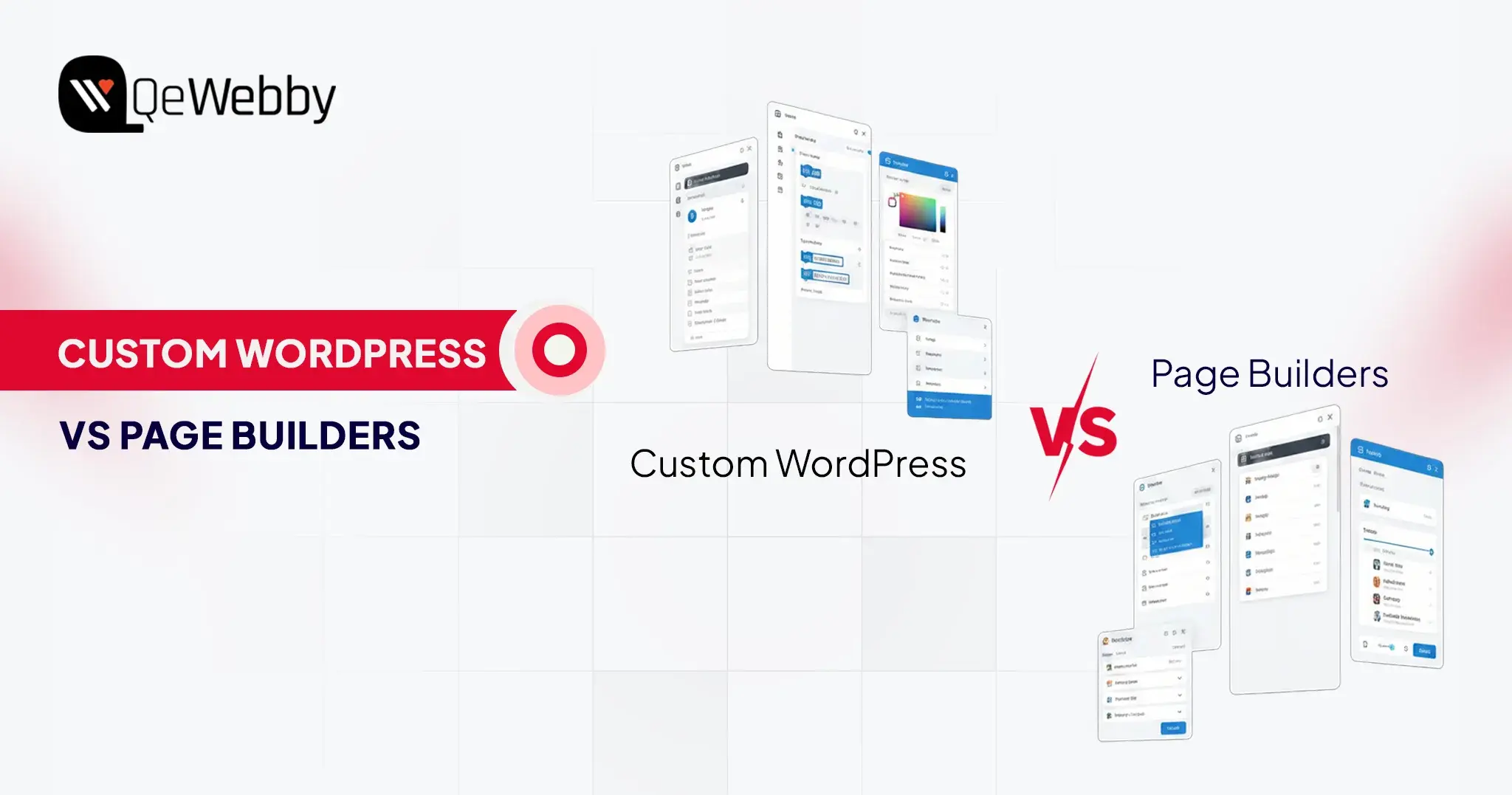
This article answers it with a clear comparison between Custom WordPress vs page builders. It covers everything from technical comparison to business trade-offs. But first, let’s understand each of these approaches individually.
What is Custom WordPress Development?
According to W3Techs, WordPress powers over 43% of all websites globally, making it the most widely adopted content management system. For B2B businesses, this dominance translates into long-term stability, a mature ecosystem, and strong compatibility with enterprise tools and integrations.
Custom WordPress development is an approach to building your website customized to specific business goals. This includes developing custom themes and templates with the exact content structure you need to cater to your audience.
A custom WordPress website has purpose-built components that offer functionalities as per your business requirements. Whether you need an ROI calculator that integrates with your CRM or want to create a resource library for gated content or lead scoring, it allows you to design and develop a site tailored to your needs.
A custom WordPress solution offers,
- Optimized database queries that make your site faster
- Tailored integrations that connect your site with the systems you need.
- Brand differentiation through customizations of themes and templates
- Optimal performance, both technically and SEO-based
- Advanced SEO and structured content to improve visibility across channels
What are WordPress Page Builders?
WordPress page builders are drag-and-drop interfaces that let anyone build webpages without coding. It comes with pre-built blocks, widgets, and templates, which you can assemble to create high-performance websites.
It offers a live preview editor that lets you drag and drop hero sections, testimonial sliders, pricing tables, and contact forms. You can even tweak colors, fonts, and spacing with sliders without knowledge of CSS. Plus, it offers pre-built templates like “SaaS Landing Page,” and you can even add your custom logo. After all of this, your site will be ready to launch, and that too in hours and not weeks.
But its biggest advantage is also its most significant disadvantage. You don’t have control over how elements, functions, and components behave whenever a user interacts. Plus, maintaining branding consistency becomes complex.
But does that mean custom WordPress development is better?
Let’s evaluate custom WordPress development vs. page builders using different criteria.
Custom WordPress vs Page Builders: Key Comparison Areas
B2B businesses choose the web development approach based on what compounds revenue over time. Here is a comparison of custom WordPress development vs page builders.
| Comparison Area | Custom WordPress | Page Builders | Winner for B2B Scale |
|---|---|---|---|
| Performance & Core Web Vitals | Lean code, optimized assets, 90+ Lighthouse scores. Your pricing page loads in 1.2s | Bloated DOM, unused CSS/JS everywhere. 50-70 Lighthouse scores are typical | Custom – Speed wins SEO and conversions |
| SEO & Content Structure | Granular HTML control, custom schema, semantic content models, | Limited markup, bloated layouts dilute semantic signals | Custom – Google rewards clean structure |
| Scalability & Long-Term Growth | Handles 100k+ pages, complex content types, deep integrations | Restrictive at 10k+ visitors, content sprawl kills performance | Custom – Built for your 5-year roadmap |
| Flexibility & Custom Integrations | Deep CRM/automation connections, purpose-built functionality | Plugin-dependent, shallow integrations, API limits | Custom – Your workflows, not vendor limits |
| Time-to-Market | 4-8 weeks planning + build | 1-2 weeks drag-drop-launch | Page Builders – Speed for MVPs |
| Maintenance & Technical Debt | Clean architecture, dev-friendly, future-proof | Lock-in, upgrade breakage, "spaghetti code" inheritance | Custom – Lower lifetime ownership cost |
| Cost Over Time | $20-50k upfront, $2-5k/year maintenance | $5-15k upfront, $10-30k/year bloat fixes + migrations | Custom – ROI compounds Year 2+ |
1. Performance and Core Web Vitals
- Did you know ? "Google officially confirms that Core Web Vitals are a ranking factor, meaning site architecture, code efficiency, and performance directly influence search visibility."
2. SEO and Content Structure
Custom WordPress development with custom theme development. WordPress practices enable granular control over HTML, schema markup, and semantic content models through WordPress SEO best practices, allowing precise structured data for rich snippets in B2B searches like “ERP software comparison.”
This approach follows Elementor vs custom WordPress comparisons, where custom builds produce cleaner code that boosts indexing and visibility, unlike Gutenberg vs page builders, where native blocks offer better semantic output than bloated plugins. Page builders like Elementor generate generic divs and bloated layouts that dilute crawler signals and weaken topical authority over time. Clean architecture combined with strong UI/UX design helps reduce friction and improve task completion.
3. Scalability & Long-Term Growth
WordPress website scalability shines in custom development, supporting complex content types, API-driven catalogs, and integrations like HubSpot without dips, thanks to its optimized architecture.
Page builders restrict growth due to nested elements causing content sprawl and slowdowns at scale, often requiring migrations that harm SEO equity. Custom setups align with long-term roadmaps, avoiding the limitations of Gutenberg vs. page builders on high-traffic sites.
4. Flexibility & Custom Integrations
Custom WordPress sites support advanced API integration services that connect CRMs, analytics, and internal systems without plugin limitations.
Page builders depend on plugins for integrations, risking shallow APIs, rate limits, and breakage during updates, as highlighted in Elementor vs custom WordPress analyses. This flexibility supports WordPress performance optimization by minimizing dependencies.
5. Time-to-Market
Page builders accelerate launches to 1-2 weeks via drag-and-drop, making them ideal for MVPs in demand gen or pilots where speed trumps depth. Custom WordPress projects require 4-8 weeks of planning to build robust foundations that reduce future rework and support evolution. Balance depends on urgency versus WordPress website scalability needs.
6. Maintenance and Technical Debt
Custom builds provide a clean, modular architecture for easy updates and no vendor lock-in, enhanced by WordPress performance optimization techniques such as lean queries. Page builders create proprietary lock-in, upgrade issues, and spaghetti code that raise costs for teams. Ongoing QA and testing services help ensure updates and new features don’t degrade performance over time.
7. Cost Over Time
According to McKinsey, unresolved technical debt can consume 20–40% of an organization’s IT budget, slowing innovation and increasing long-term costs.
Page builders have lower upfront costs but incur higher costs for fixes and migrations due to bloat. Custom WordPress costs more initially but yields savings in maintenance and SEO gains, as custom solutions outperform in the long term.
Which Option Fits Your B2B Business? (Decision Framework)
Before choosing the best option for your web development, ensure it aligns with your lead generation and retention goals. To make this decision more accurate, here is a framework you can use,
Choose Page Builders if,
Leverage a page builder only when you need speed over customizations or are looking to launch a minimum viable product. It suits best for temporary assets or microsites. The performance of the website you get is basic and there are no deep custom integrations.
- Campaign Landing Pages: Deploy event promos or webinar signups in days for A/B testing lead magnets.
- MVP Prototypes: Validate SaaS demos or quick commerce pilots with non-technical teams.
- Temporary Microsites: Run seasonal product launches or partner co-branded pages without long-term commitment.
- Small Agency Sites: Basic service showcases under 1k monthly visitors, where drag-drop speeds client delivery.
Choose Custom WordPress If,
Select custom WordPress development to build scalable platforms which can offer better SEO optimixations, customizations and integrations. It is the most suitable for enterprise B2B companies with complex workflows, offering better Core Web Vitals.
- Enterprise Content Hubs: Scale resource libraries, case studies, and blogs to 100k+ pages with semantic SEO.
- Integrated Lead Funnels: Sync ROI calculators, gated ebooks, and CRM scoring for nurturing pipelines.
- High-Traffic Portals: Handle surges from LinkedIn campaigns or webinars with optimized Core Web Vitals.
- Custom Workflows: Build demo schedulers, analytics dashboards, or API-driven catalogs for CTO audiences.
Hybrid WordPress Strategy: When It Makes Sense for B2B
Many B2B companies adopt a hybrid WordPress strategy that leverages custom development as the core foundation while incorporating selective Gutenberg blocks or lightweight page builders for targeted marketing needs.
This approach delivers marketing flexibility through drag-and-drop editing on specific pages without compromising site-wide performance or scalability. Custom themes provide optimized architecture, lean code, and deep integrations, while Gutenberg’s native blocks enable non-technical teams to handle content updates efficiently.
Core Foundation
Selective Builder Use
Benefits for B2B Scale
Final Note
No universal “right” choice exists between custom WordPress and page builders; success depends on your B2B stage and revenue goals. Startups benefit from page builders’ rapid 1-2-week launches for MVPs and A/B testing, delivering quick ROI via low costs and fast demand generation.
Page builders offer short-term speed but dilute SEO over time. Custom development’s upfront investment yields long-term savings, and hybrid flexibility with Gutenberg for marketing pages without performance trade-offs. For B2B sites as revenue engines, prioritize scalable architecture over design ease.

Anubhuti Rathod
Content Marketing Manager
Anubhuti has spent nearly a decade crafting content strategies that make WordPress websites work harder. At QeWebby, she owns the full content marketing function, turning technical capabilities into audience-ready messaging that drives qualified traffic and leads.
Frequently Asked Questions
#1. What is the main difference between custom WordPress and page builders?
#2.Is custom WordPress better than page builders for B2B websites?
#3. Are WordPress page builders bad for SEO?
#4. Which option scales better for growing B2B companies?
#5. Do page builders affect website performance and Core Web Vitals?
Yes, page builders often affect Core Web Vitals by loading unused CSS, JavaScript, and nested elements, which can increase load time and layout instability.