







Headless WordPress Development Services for High-Performance Websites
We provide enterprise-grade headless WordPress development services for US companies ready to break free from the limitations of traditional monolithic WordPress.
Headless WordPress Development Services Tailored to Your Needs
-
Headless WordPress Architecture Design
Our team of expert headless WordPress developers audits your existing stack, builds a full architectural blueprint, and sets up either a REST API or WPGraphQL layer to connect your content with your chosen frontend environment.
-
Frontend Frameworks Integration
As a specialized headless CMS development agency, we build your frontend framework selection around your performance goals, team skillsets, and content distribution needs — using Next.js, Nuxt.js, Gatsby, or Astro.
-
WPGraphQL and REST API Development
-
WordPress Content Modeling and CMS Configuration
We configure custom post types, Advanced Custom Fields (ACF), taxonomies, and content relationships so that every data field is available to your frontend, without requiring additional custom code.
-
Multi-Channel Content Distribution Setup
As a leading headless WordPress development company, we set up WordPress as a centralized content source powering your website, web applications, and mobile apps simultaneously, expanding your content reach without duplicating effort.
-
Performance Optimization and Deployment
Every engagement includes a full performance program: static generation, incremental static regeneration (ISR), CDN deployment, image optimization, and Core Web Vitals auditing — so your site launches fast and stays fast.
Our Numbers Speak Louder Than Promises Made
Your End-to-End White-Label Headless WordPress Development Partner
QeWebby works as your end-to-end headless WordPress execution partner, providing you with the architecture, development, and QA management while remaining completely invisible behind your brand name. We are one of the select few headless cms development agencies partners who offer end-to-end services, integrating into your workflows seamlessly.
- Full headless architecture design, development, and QA
- Customizable reporting in your preferred format and cadence
- Scales from a single project up to 30 total clients

Why Every Growing US Business Needs Headless WordPress Architecture
There are measurable, real-world limitations to running a monolithic WordPress setup and they are already costing businesses in performance, developer productivity, and scalability.
Monolithic WordPress Is Holding Your Team Back
Plugins are bloated, PHP rendering holds you back, and you’re locked into the same old themes.
Your Frontend Teams Deserve Freedom
At our headless WordPress development company, we let developers build interfaces according to the chosen framework for every single project.
Page Speed Directly Impacts Revenue
With a headless approach to web development, there is no need for PHP rendering, as interfaces run on static HTML served via CDN from an edge node.
Distribute Content Across Every Platform
When you choose to collaborate with a headless WordPress development service provider, you create a solid content backbone across all platforms, web, mobile, and app alike.
Reduce Your Security Surface Area
Without a publicly available WP-admin panel and with static files only, the attack surface area for your security department to manage shrinks.
Early Choices Have Long-Term Payoff in Architectures
Save time and money on every future update by choosing the headless WordPress architecture now.
Our 4-Phase Process for Building Headless WordPress Sites
1
Site Architecture Audit & Blueprint
We audit your WordPress stack and deliver a full architectural blueprint before any development begins.
2
Content Modeling & API Layer Setup
We restructure your content models and configure the API layer your frontend will consume.
3
Frontend Design & Component Development
We build every component against real WordPress API data, so nothing breaks at launch.
4

Performance Optimization & Site Launch
We optimize in parallel with development, so you launch fast, not just finished.


Still Running on a Monolithic WordPress Setup?
The longer you wait, the more you pay in developer friction, slow page speeds, and limited content reach. Our headless WordPress development company gives you the architectural separation you need to build faster, publish smarter, and scale without limits.
Our Headless WordPress Technology Stack
Every headless WordPress development services engagement at QeWebby uses a proven, production-tested stack, selected for performance, scalability, and long-term maintainability.










Understanding Headless WordPress for High-Performance Development
At QeWebby, we architect headless systems based on how modern frontend applications actually consume content, not how WordPress was originally designed to deliver it.
What is Headless WordPress?

Headless WordPress is an approach where WordPress manages content, while a separate frontend application handles how that content is displayed. The two are connected through an API, usually the WordPress REST API or WPGraphQL, instead of traditional PHP templates.
Many teams mistake headless for using a page builder or a modern theme, but that’s not the same thing. Traditional WordPress tightly combines content, logic, and presentation. Headless separates them. For that separation to actually deliver value, three things need to be in place:
- A structured content model built for API delivery, not template rendering
- A stable API layer that frontend teams can rely on without breaking changes
- A frontend deployment strategy using static generation, ISR, or SSR via a CDN
Simply adding a REST endpoint to an existing WordPress site isn’t enough. A proper headless setup involves redesigning the content model, stabilizing the API, and building the frontend against real data from the start. That’s what separates a quick prototype from a system that performs at scale.
What is a Headless CMS?

A headless CMS stores and delivers content via APIs without controlling how it appears on the frontend. WordPress can function this way when configured for headless delivery, just like platforms such as Contentful, Sanity, or Strapi.
- How well your content model aligns with frontend components
- How stable and scalable your API structure is
- Whether your editorial team can preview content before publishing
At QeWebby, editorial workflow continuity is treated as a core part of the build, not an afterthought.
Headless WordPress vs Traditional WordPress vs Custom CMS
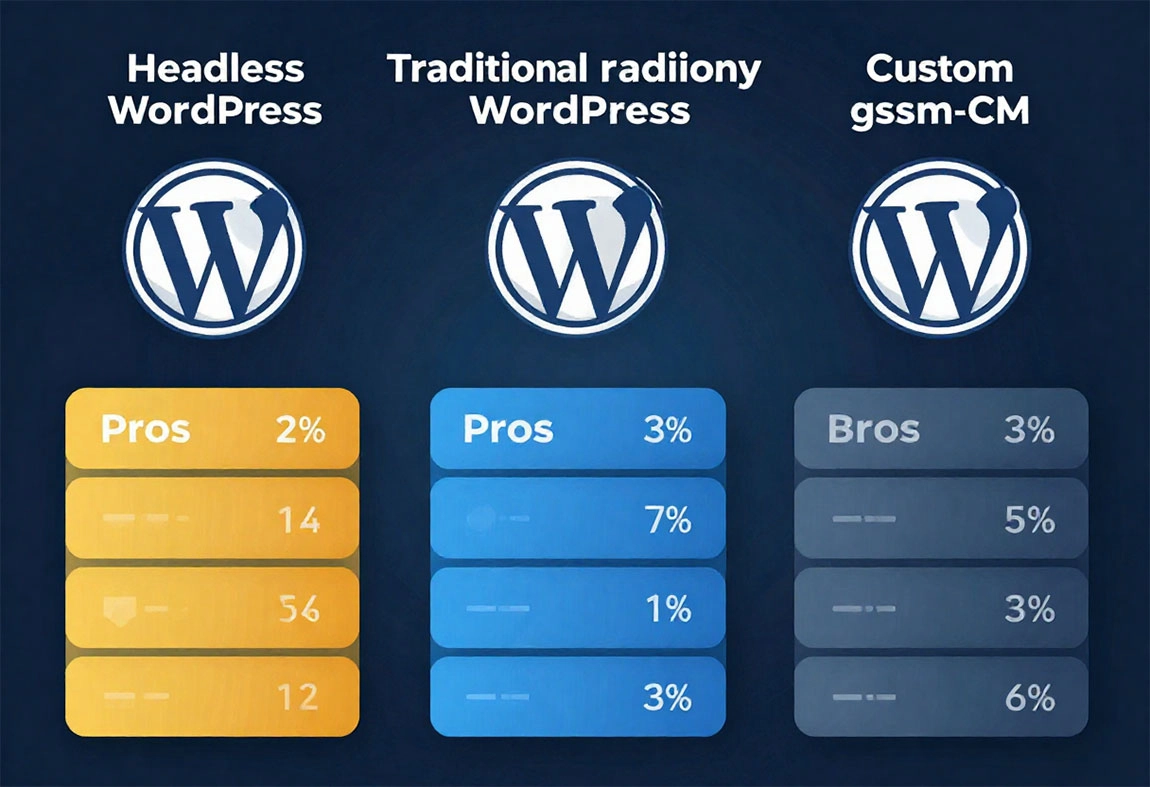
Headless WordPress separates concerns. WordPress handles content, while a modern frontend framework handles presentation. Success is measured by API performance, frontend speed, and consistency across platforms.
| Factor | Traditional WordPress | Headless WordPress |
|---|---|---|
| Architecture | Tightly coupled (theme + PHP) | Decoupled (API + modern frontend) |
| Frontend Freedom | Limited to themes/page builders | Full — any framework (Next.js, etc.) |
| Page Speed | Plugin-dependent | Structural (CDN + static HTML) |
| Multi-channel | Web only | Web, Mobile, App, IoT |
| Security | WP-admin exposed | Static frontend, no exposed admin |
| Build Timeline | 2–6 weeks | 6–14 weeks |
| Long-term Scalability | Limited | High |
How Headless Architecture Improves Development Velocity?
Headless changes how teams build. Frontend developers are no longer constrained by WordPress themes; they can use modern frameworks like React, Vue, or Next.js while working against a stable API. This removes a major source of friction between developers and content teams.
Why It Matters for Your Business?
Without headless architecture, teams often spend time working around WordPress limitations instead of building meaningful features. Users experience slower load times, and content is often limited to a single channel.
This isn’t just a technical decision; it directly impacts cost, performance, and growth.
Where the risk is highest:
- Teams needing modern frontend frameworks but stuck in theme systems
- Businesses distributing content across multiple platforms
- Sites struggling with Core Web Vitals despite optimization efforts
What a strong headless implementation delivers:
- A scalable content system without increasing plugin complexity
- Faster frontend development as components and APIs stabilize
- Measurable performance gains that improve conversions and visibility
What Results Can You Expect from Headless WordPress?

When implemented properly, headless WordPress follows a predictable value progression:
- Weeks 6–8: Content model finalized, API configured, staging frontend live with real data
- Weeks 8–12: Production frontend deployed on CDN edge — Lighthouse scores above 90
- Weeks 12–16: Multi-channel content distribution live, full editorial preview workflows active
Headless WordPress Development Services Built for US Businesses
FAQs
What is headless WordPress?
How is headless WordPress different from traditional WordPress?
Traditional WordPress tightly couples content management and frontend rendering in a single PHP system. Headless WordPress separates them completely — WordPress handles content, a modern frontend framework handles presentation, and both can be scaled and deployed independently. The result is faster pages, more frontend freedom, and better long-term maintainability.
How much does headless WordPress development cost?
Headless WordPress development project costs vary based on content complexity, frontend requirements, and integration scope. QeWebby offers fixed-scope project models and ongoing retainer engagements. Most initial builds range from a defined architecture sprint through full production deployment. Contact us for a scoped estimate based on your specific stack.
What frontend frameworks work with headless WordPress?
Can you migrate our existing WordPress site to headless?
Yes. Most existing WordPress content can be migrated to a headless architecture without rebuilding from scratch. We audit your current content model, identify what needs restructuring, and build the new headless layer alongside your existing site — minimizing editorial disruption during the transition.
Do I need to rebuild my existing WordPress content to go headless?
Not necessarily. Existing content can often be consumed directly from the API. However, content types, custom fields, and taxonomies may need restructuring to map cleanly to your new frontend components. Our headless CMS development agency process includes a content model audit to determine exactly what needs updating and what can be used as-is.
How long does headless WordPress development take?
Most QeWebby projects follow this timeline: 6–8 weeks for content modeling, API configuration, and a staging frontend with live content; 8–12 weeks for a production-ready CDN deployment with Lighthouse scores above 90; 12–16 weeks for full multi-channel publishing and editorial preview workflows. Existing sites with clean content models are faster to migrate.
Will a headless WordPress website rank better on Google?
Yes, in most cases. Headless WordPress delivers structural SEO improvements — not incremental ones. Eliminating PHP from the render path and serving static or server-rendered HTML from edge CDN nodes significantly improves Core Web Vitals scores. QeWebby projects consistently achieve Lighthouse performance scores above 90 on both mobile and desktop.
What is the difference between headless WordPress and Contentful?
Both are headless CMS options, but WordPress gives your team a familiar editorial interface, a large plugin ecosystem, and full content ownership — without vendor lock-in or per-seat pricing. Contentful is a strong dedicated headless CMS, but switching from WordPress means migrating all existing content and retraining your editorial team. For most B2B companies already on WordPress, headless WordPress is the lower-risk, faster path to modern architecture.