











Table of Content

Agency owners treat a hiring plan as the default answer to cope with massive workloads. However, the numbers behind that plan rarely survive the bottlenecks of the actual talent market.
McKinsey’s March 2025 analysis of the technology talent gap highlights talent scarcity as a significant barrier to digital transformation. For agencies, this raises an important operational question: Is hiring the fastest and most sustainable way to increase development capacity?
So the question is not whether your agency needs more development capacity. It is whether a hire is even the fastest way to get it. This is where white label web development enters the picture, and where most guides stop at a definition instead of the decision behind it.
This guide explains how white label web development works, how it differs from other delivery models, what costs and risks to consider, how project handoffs are managed, and when hiring or another partnership model may be a better fit.
What is White Label Web Development?
Most agencies think white labeling is just outsourcing with better manners. However, once you look at how the contract, the brand, and the client relationship actually work, the difference is structural, not cosmetic.
White Label Web Development is a B2B arrangement where a specialized third-party development company builds websites, web applications, or digital products on behalf of another agency. Your agency buys these white-label web development services at wholesale rates, sets your own retail pricing, and sells the finished work entirely under your own brand.
The development partner runs as a silent execution engine behind the scenes. They stay 100% invisible to the end client. No code footprints, meta tags, style sheet credits, directory paths, or branding traces link the site back to the backend partner. Your agency keeps full ownership of the client relationship, the strategy, and the credit for the delivered product.
So, what does this actually cover?
Custom builds across WordPress, Webflow, Shopify, and React. E-commerce setup, custom database configuration, API integrations, and ongoing post-launch maintenance retainers. The scope is the full technical execution layer, not a slice of it.
What White Label Web Development is Not
1. Not Traditional Outsourcing
Traditional outsourcing hires an external vendor to deliver a project, but it typically skips brand integration. The end client usually knows a third party is doing the technical work.
When providing white label web development services, the partner operates as a seamless, invisible extension of your agency. The team signs strict Non-Disclosure Agreements (NDAs), works behind neutral or agency-branded staging environments, integrates into your project management tools like ClickUp, Slack, or Asana, and can even run an alias email under your domain, for example [email protected].
2. Not Freelancing
Freelance developers are a common tactical move. However, this route carries real systemic risk: inconsistent quality, fragmented accountability, no project management, and the chance a developer ghosts mid-build.
A proper white label web development agency hands you a full project team, project managers (PMs), UI/UX designers, developers, and QA testing protocols.
3. Not a Reseller Model
Reseller programs sell a named, visible third-party SaaS platform to your clients at a set markup. The reason behind such a scenario is simple: the vendor’s brand stays fully visible, so your agency has limited pricing control and constant risk of the client going straight to the vendor.
In white-label web development, the supplier’s identity is stripped out entirely. This is where the model gives your agency 100% pricing autonomy and client retention.
4. Not a Commission or Referral Program
Commission programs are simple: you pass a lead to a software vendor or dev firm and take a percentage of the sale. Once you refer the client, you give up pricing, delivery quality, and long-term retention.
In a white-label model, you own the contract, the billing relationship, and the deliverable.
5. Not a Joint Venture
A Joint Venture (JV) is co-branded and co-managed, with two entities splitting operational responsibility and revenue on a pre-negotiated split, typically 50/50, often with combined pitch decks and joint client meetings.
White labeling is structurally a customer-supplier relationship. The provider builds the site at a wholesale rate, and your agency marks it up, typically targeting 50 to 70% gross margins, and keeps 100% of the profit.
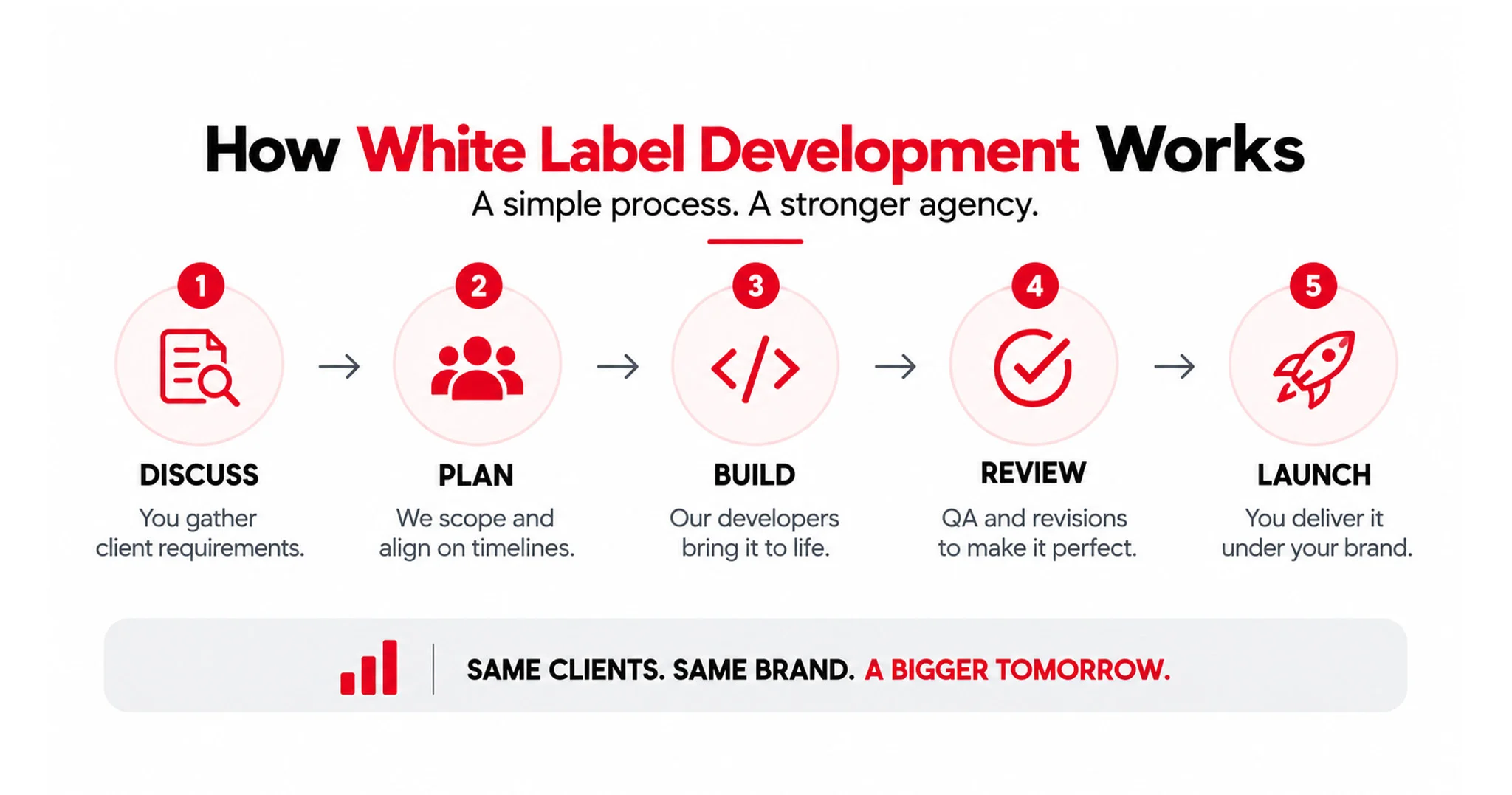
Why Agencies Are Shifting to White Label Web Development
Most agencies believe growth is a headcount problem: more clients means more developers on payroll. However, that relationship breaks the moment a growth curve isn’t perfectly linear, and agencies are turning to white label web development to fix exactly that bottleneck.
So, what’s actually driving the shift? Here are the reasons.
1. Breaking the Linear Scaling Bottleneck
In traditional growth models, taking on more client accounts forces a proportional increase in in-house technical headcount. However, running a full-time internal engineering department carries real fixed costs.
This fixed cost becomes a liability the moment client volume dips, whether from seasonality or a broader downturn. White label partnerships can also help agencies expand their ecommerce service offerings
Verdict: fixed engineering headcount scales with your worst month. Variable white label capacity scales with your actual pipeline.
2. Resolving Talent Scarcity and Sourcing Risk
Recruiting and onboarding technical talent is slow. The reason behind such a scenario is straightforward: qualified developers are in short supply relative to demand, and hiring cycles routinely stretch across months.
Freelancers are one workaround. However, freelancing carries systemic risk: inconsistent delivery quality, no structured project management, and the real chance a developer disappears mid-project.
A structured white label web development agency solves this differently by handing you a full team, project managers, developers, and QA, with built-in redundancy, so the project keeps moving even if one person is unavailable.
Verdict: a white label partner replaces individual hiring risk with team-level redundancy.
3. Expanding Service Portfolios and Deal Size
Clients increasingly want one full-service partner instead of five fragmented vendors. That preference puts pressure on specialized shops, SEO-only or branding-only agencies, to add web development to the menu.
Partnering with a provider for full-stack white label website development adds those platforms to your service menu without adding headcount.
So, what does that unlock? The ability to sell platform builds and custom development alongside your existing services, instead of referring that work out and losing the margin entirely.
Verdict: portfolio breadth is what turns a single-service vendor into a full-service agency of record.
4. Accelerating Speed to Market
Recruiting and onboarding a new in-house developer is a multi-month process end to end. An established white label partner, by contrast, already has the team in place. Scoping and kickoff timelines run in days rather than months, because there’s no hiring cycle standing between the brief and the build.
This is where speed compounds: faster kickoff means faster delivery, which means your agency can commit to tighter client timelines without overstaffing to hit them.
Verdict: the fastest path to shipping a client site is a team that already exists.
5. Creating Predictable, High-Margin Revenue
Offshore white label developers, often based in talent-dense hubs like India, typically operate at a lower cost basis than US or UK in-house hires. Your agency buys development at wholesale rates and resells it at your market rate, capturing the margin between the two.
Post-launch maintenance is the second revenue layer. Security updates, performance tuning, and general upkeep wrap into a monthly retainer that your agency marks up and bills recurring.
Verdict: white label execution turns one-time project revenue into a recurring, marked-up line item.
6. Freeing Teams for High-Value Work
Managing code, server deployments, database integrations, and technical troubleshooting pulls agency leadership away from growth work. So, what happens when a white label partner absorbs that layer silently?
Your internal team redirects its attention to client relationships, account strategy, creative direction, brand positioning, and selling- the work that actually grows the agency.
Verdict: the technical execution layer and the growth layer are different jobs, and white labeling lets you staff them separately.
Ultimately, the scaling bottleneck isn’t a talent problem or a tooling problem. It’s a cost-structure problem, and white label web development is the mechanism that fixes it.
How a White Label Web Development Partnership Actually Works
Most agencies picture a white label partnership as a ticket queue: submit a request, wait, hope for the best. However, a properly run partnership behaves nothing like that. It functions as an invisible, full-service engineering department, one where your agency keeps absolute ownership of the client relationship, the brand narrative, and the margin.
So, what makes that operating reality possible? Structured standard operating procedures (SOPs), integrated communication systems, and strict legal protocols. Here’s how the mechanics actually run.
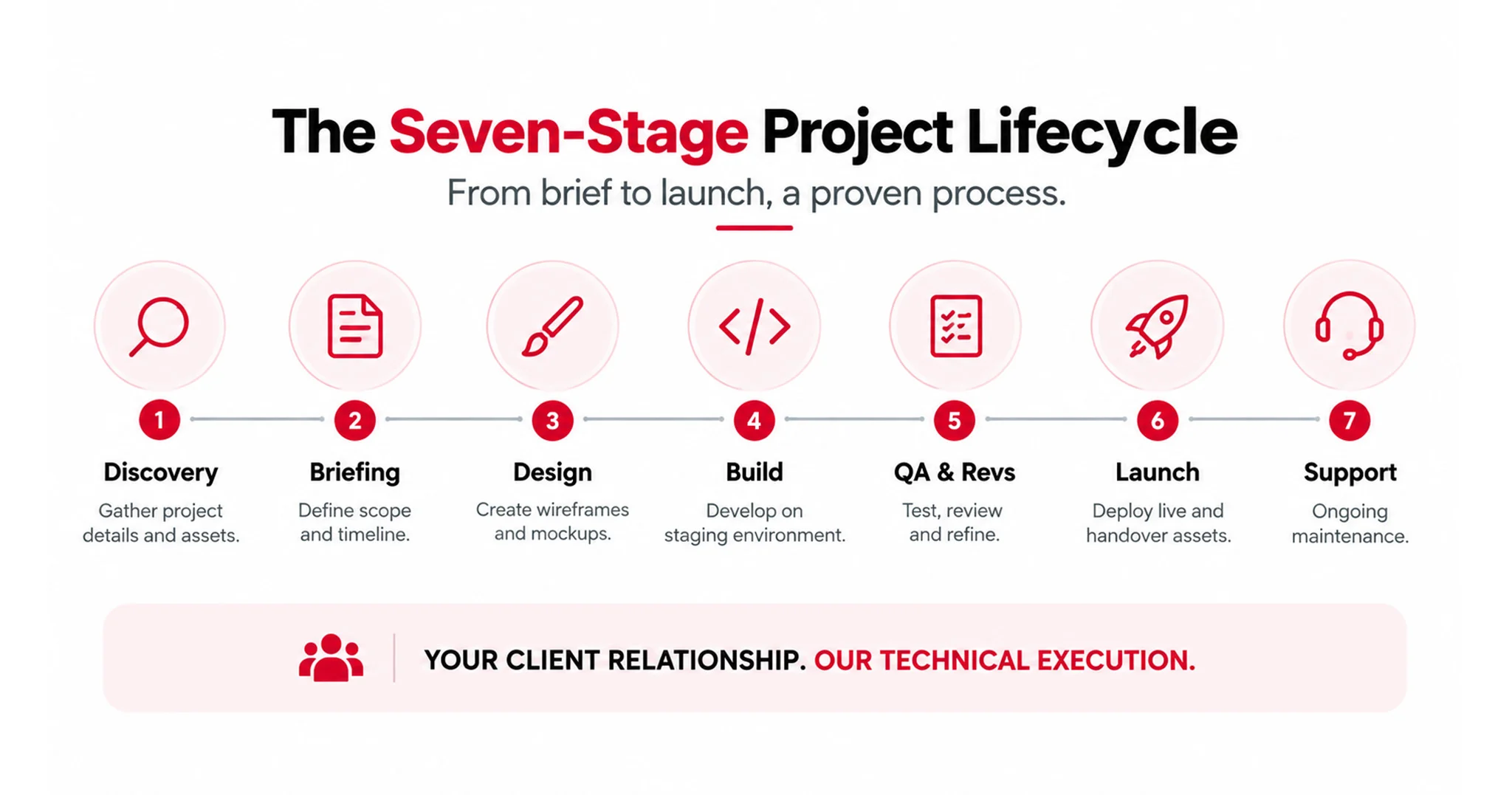
1. The Seven-Stage Project Lifecycle
| THE SEVEN-STAGE LIFECYCLE | |
|---|---|
| 1. Discovery | Agency gathers sitemap and assets from client |
| 2. Briefing | Agency translates brief; partner locks scope/timeline |
| 3. Design | Visual wireframes/mockups signed off before coding |
| 4. Build | Partner writes code in isolated staging environments |
| 5. QA & Revs | Joint review passes; structured revisions completed |
| 6. Launch | Partner deploys live; hands over rebranded assets |
| 7. Support | Transition to monthly white-labeled maintenance |
Stage 1: Discovery and Requirements Gathering
You are the main strategic consultant for your agency, meeting with the end client to gather your client’s business objectives, target audiences, brand guidelines, and page count requirements. At this point, it’s all up to you and your agency. That’s what keeps partner invisibility safe during white label website development.
A good way to get started is to ask the client what he or she doesn’t like about the existing website, rather than asking what they want. This question helps to identify more technical pain points.
Stage 2 Briefing & Planning
Your agency passes over the creative brief, layout files, API needs, and branding elements to the white-label developer. The Developer will review all the above and identify the areas of gaps along with a fixed scope quote with a locked timeline and milestone dates.
Stage 3: Design, Wireframing, and Prototyping
Designers use the requirements to create visual sitemaps, wireframes, and interactive mockups, mostly in Figma. A designer uses the requirements to build visual sitemaps, wireframes, and interactive mockups, mostly in Figma.
Client sign-off on the mock-up is required. The answer to such a situation is very simple- when making changes to the layout, it is inexpensive to do so in a design file, but once development is underway, it is costly to make changes.
Stage 4: Build Execution and CMS Configuration
The development partner now takes over once the design is agreed to. They write code for the front-end of the site, create custom back-end databases, and connect third-party tools, e.g., CRMs or payment gateways. Preventing client-facing errors, each build is performed on isolated and secure staging servers instead of live servers.
Stage 5: Internal QA & Structured revisions:
The build is subjected to a comprehensive checklist by the partner’s own Quality Assurance (QA) team before it’s ever viewed by the agency: mobile responsiveness, cross-browser compatibility, form submission, and Web Content Accessibility Guidelines (WCAG) standards and Core Web Vitals page speed.
Your agency checks the website, then leads the client through a series of steps to revise the site, usually two to three rounds of revisions as outlined in the master agreement.
Stage 6: Launch and Handover
Once the white label web development services are complete and the client signs off, the partner will handle live deployment. After they are live, they provide you with all their clean source code, credentials, and documentation with your brand name.
Stage 7: Continuous Maintenance and Support:
The project is handed over to the partner’s maintenance team. They ensure that there are no downtimes, they install security patches, and they execute backups in your agency’s name. Recurring revenue begins here: Your agency sells the client maintenance retainers at a high premium.
Verdict: the seven stages exist to draw one line clearly: client-facing work stays with your agency, execution work stays with the partner, and the two never cross.
2. How Invisibility is Maintained in Practice
Email Aliases And Name Masking
If the development team needs to join client calls, they’re introduced under your agency’s banner, as your “senior dev team lead” or “engineering partners,” with zero mention of their independent brand. Where direct client email is necessary, the partner works under an alias on your domain, for example [email protected].
Neutral Staging Environments
Staging URLs and client-review portals are fully white-labeled, configured on neutral domains or your agency’s subdomains, for example staging.youragency.com, with your agency’s logo on the login screen.
Zero-Footprint Code Cleanliness
A genuinely professional white label web development agency strips all metadata. Stylesheets, theme folders, databases, plugins, and source code comments get scrubbed of any trace of the third-party developer’s brand. A technically curious client should not be able to find the seam.
Verdict: invisibility isn’t a courtesy; it’s an operational discipline enforced at the domain, login screen, and code comment level.
3. Integrated Workflows and Communication
The partner doesn’t operate as an isolated black box where you submit tickets and wait. However, a properly structured partnership makes them an active extension of your team instead.
Dedicated project managers (PMs). You get a single, named point of contact acting as your account lead. Your agency’s PM communicates directly with the partner’s PM, which keeps client feedback translation clean and avoids the telephone-game problem.
Shared project dashboards. The partner plugs directly into your existing project management stack, ClickUp, Slack, Asana, or Jira. Your team sees sprint boards, active milestones, and QA reports in real time.
Asynchronous rhythms. For teams spread across time zones, offshore developers in India optimizing build cost is a common setup; a daily asynchronous update rhythm keeps both sides aligned. A short written summary at the end of each workday replaces the need for constant live syncs.
Verdict: the difference between a black-box vendor and a real extension of your team is whether you can see the sprint board without asking for it.
4. Legal and Structural Safeguards
Before a single project asset or database changes hands, three contracts formalize the relationship and protect your agency’s brand equity.
Non-Disclosure Agreement (NDA)- binds the partner to absolute confidentiality, contractually prohibiting them from claiming credit for the work, showcasing your projects in their portfolio, or disclosing the relationship with your agency.
Non-solicitation and non-compete clauses- prevent the developer from poaching your clients, pitching services directly, or bypassing your agency in any way.
Intellectual Property (IP) assignment- specifies that 100% of the custom source code, design assets, and licenses transfer to your agency on final payment, so you’re never locked into one vendor and can take the code wherever you need to.
Verdict: the NDA protects your invisibility, the non-compete protects your client base, and the IP assignment protects your leverage. Skip any one of the three and the arrangement stops being white label and starts being a liability.
Ultimately, a white label partnership works because every stage, every communication channel, and every contract is built around one line: your agency owns the relationship, the partner owns the execution, and neither side crosses it.

Final Thoughts
The decision is not “should my agency use white label web development.” It is “do I hire, or do I partner, at my current volume,” and that question has a number attached. Deloitte’s 20%-plus savings figure for centrally governed delivery, and McKinsey’s finding that 60% of companies name talent scarcity as a transformation blocker, both point the same direction for any agency running below its break-even volume: a partner wins on cost and on hiring risk until volume says otherwise.
So, run a scoped pilot project before you run a hiring process. It answers the question faster, and it costs less to be wrong when testing white label web development services


Bhargav Dave
Operations and Client Services
Bhargav keeps QeWebby's delivery engine running. With a PRINCE2-certified background in project management and client operations, he ensures every WordPress project, from agency white-label to WooCommerce build, is delivered to scope, on schedule.
Frequently Asked Questions
#1.What Is White Label Web Development?
White label web development is an arrangement in which an external development partner completes technical work for an agency, which then delivers the service to its client under the agency’s brand.