















The global headless commerce market is experiencing explosive growth, expanding from an estimated $1.74 billion to a projected $7.16 billion by 2032 at a 22.4% CAGR. This trajectory is not merely driven by developer enthusiasm but by concrete commercial results: businesses adopting headless architecture report an average 42% increase in conversion rates following implementation.
Traditional WordPress was built for an era when a website had a single frontend and a single audience. However, for growth-focused teams operating under performance pressure, this business guide to headless WordPress cuts through the technical framing. It maps the architectural shift directly to revenue, scalability, and competitive positioning.
What is Headless WordPress and How Does It Work?
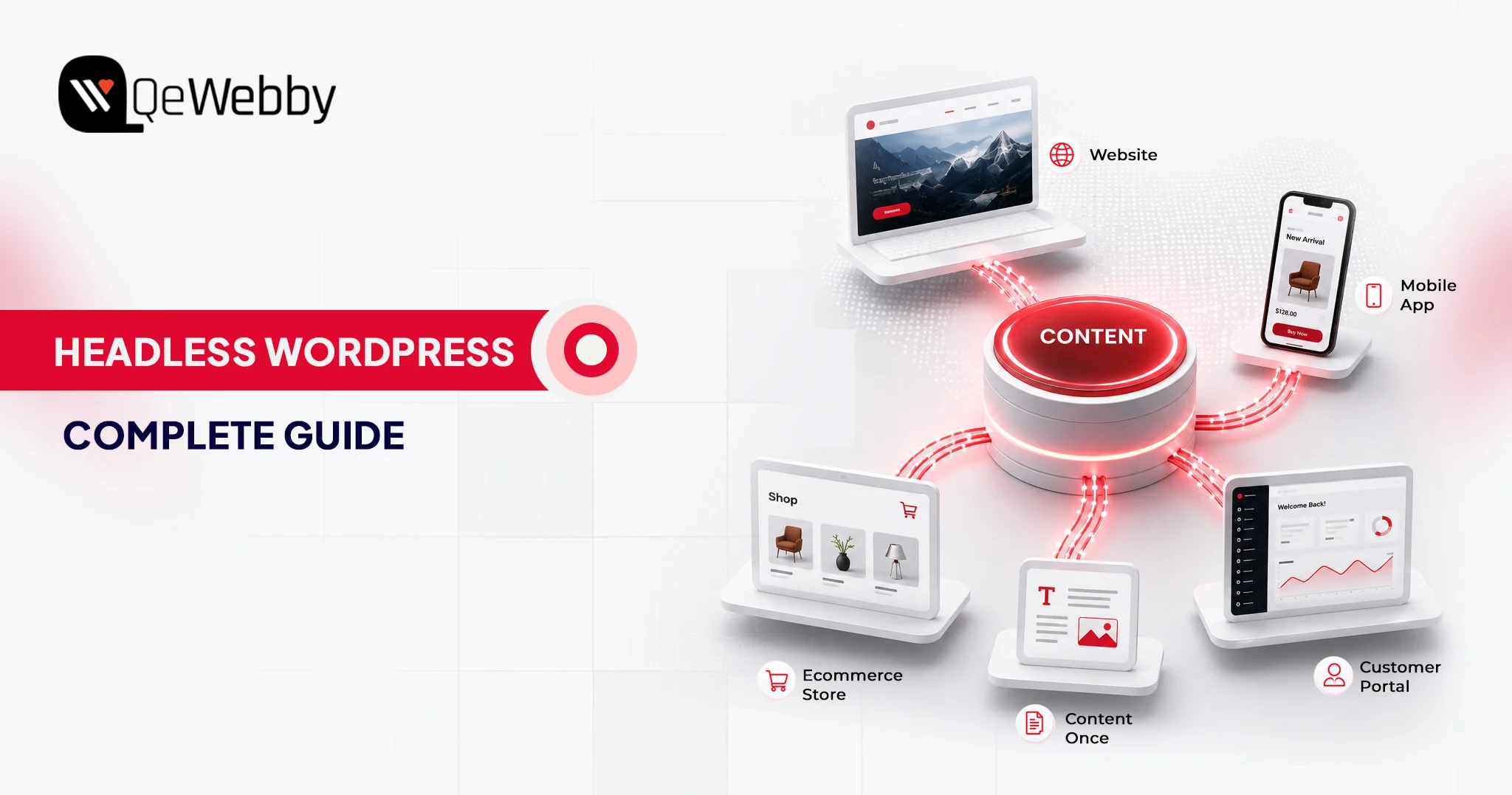
Headless WordPress decouples the content management layer from the frontend presentation layer. WordPress handles content storage and API-based delivery, while a modern JavaScript framework renders the user-facing experience independently.
That separation allows development teams to build faster, more flexible frontends without the constraints of WordPress’s default themes or plugin architecture.
Traditional WordPress ties content, design, and delivery into a single monolithic system. Every page load triggers PHP execution, database queries, and server-side rendering through WordPress’s template engine before a single byte reaches the user’s browser.
A well-optimized traditional setup delivers a time-to-first-byte (TTFB) of 180-250ms. A headless Next.js frontend with incremental static regeneration (ISR) delivers that same metric at 50 to 120ms, per the 2025 benchmark. That difference at the infrastructure level compounds into measurable business outcomes.
How the Decoupled Architecture Works in Practice?
Editorial teams retain the familiar WordPress dashboard for publishing posts, managing media, and updating pages. The frontend, built on a framework such as Next.js, Gatsby, or Nuxt.js, fetches content via the WordPress REST API or the WPGraphQL plugin.
Visitors interact with a pre-rendered interface served from a CDN edge network. WordPress never touches a user-facing request directly.
That model eliminates the performance bottlenecks associated with traditional WordPress: PHP rendering overhead, plugin conflict latency, and single-server delivery constraints.
What remains is a content API proven at scale and an editorial workflow that non-technical teams already know.
The clean separation between content operations and frontend engineering is exactly what makes headless CMS solutions compelling for enterprise and growth-stage teams who need both editorial simplicity and frontend performance.
Why Growth-Focused Businesses Should Use Headless WordPress?
73% of businesses now deploy headless architecture, up 14% from equivalent research conducted in 2021, per WP Engine’s State of Headless 2024 report. Another 98% of non-adopters plan to evaluate headless solutions within the next 12 months.
The adoption curve is not a trend. It is a structural response to constraints that traditional WordPress cannot address at scale.
Growth organizations face a specific set of demands that monolithic WordPress handles poorly: traffic volatility, multi-channel content delivery, rapid UI iteration without content disruption, and frontend performance benchmarks that directly affect organic search rankings and paid acquisition efficiency.
Many businesses first encounter these limitations while scaling traditional WordPress websites through WordPress development services.
Nearly 70% of organizations cite competitive advantage as the primary driver for headless adoption, per the same WP Engine report. The architecture addresses those demands at the system level, not through plugin layers or caching workarounds that require ongoing maintenance.
Scalable WordPress Solutions for High-Traffic Operations
Scalable WordPress solutions built on headless architecture handle traffic spikes fundamentally differently from traditional WordPress deployments. In a coupled setup, a traffic surge hits the WordPress server directly, triggering PHP execution, database queries, and server-side rendering for every concurrent request. In a headless deployment, the frontend is served as pre-rendered static assets or server-side rendered pages from CDN edge nodes, and the WordPress backend receives only lightweight API requests.
79% of headless users rate their scalability as strong, compared to 62% on traditional platforms, per Swell’s commerce data. That 17-point gap is structural, not configurational.
For seasonal campaigns, product launches, or high-traffic content moments, a headless frontend absorbs demand spikes without WordPress server modifications, provisioning delays, or user-facing performance degradation.
Speed as a Revenue Lever, Not Just a Technical Benchmark
A 0.25-second improvement in load time yields a 1.75% increase in conversion rate, and every additional second of load time reduces conversions by approximately 2%, per Curious Minds Media’s performance analysis. Traditional WordPress sites with optimization plugins typically deliver page loads of 3-5 seconds for dynamic content. Headless sites served from a CDN edge network routinely load in under 2 seconds.
At scale, that difference is not marginal. For a business converting at 3% on 100,000 monthly visitors, a 1.75% improvement in conversion from speed alone represents hundreds of additional monthly leads without increasing acquisition spend.
Treating page speed as commercial infrastructure rather than developer preference is the shift growth-stage organizations need to make, and headless WordPress is the mechanism that makes it architecturally permanent.
Scalable WordPress Solutions That Strengthen SEO Through Core Web Vitals
Google’s Core Web Vitals scoring system rewards sites that deliver fast Largest Contentful Paint (LCP), low Cumulative Layout Shift (CLS), and quick Interaction to Next Paint (INP). Headless WordPress deployments consistently outperform traditional WordPress on all three metrics when implemented with server-side rendering or static generation.
One documented migration moved Google PageSpeed scores from the mid-60s and low-70s to high-90s and 100 across both mobile and desktop.
The SEO benefit compounds over time. Higher Core Web Vitals scores improve organic rankings, increasing qualified traffic volume and improving conversion output without increasing paid acquisition costs.
Plugin-based optimization on traditional WordPress closes part of that gap, but it cannot replicate the baseline performance that a CDN-delivered headless frontend produces by architectural default.

Technical Stacks for Headless WordPress in 2025
A headless WordPress implementation involves three distinct technical layers: the CMS backend (WordPress itself), the API layer, and the frontend framework.
Choosing correctly across all three determines whether the final system delivers the performance, scalability, and maintainability the business actually needs.
Each layer has meaningful options, and the decisions interact: a poor API layer choice compounds the limitations of an otherwise strong frontend framework.
The API Layer: WP REST API vs WPGraphQL
The WordPress REST API has been included natively since WordPress 4.7, released in December 2016. It exposes content as JSON endpoints consumable by any frontend framework via standard HTTP requests. It requires no additional plugins, is well-documented, and provides sufficient functionality for most standard headless implementations.
WPGraphQL is a plugin with over 60,000 active installations as of 2025 that adds a complete GraphQL implementation to WordPress, allowing frontend applications to request exactly the data they need in a single query rather than making multiple REST requests and filtering oversized responses.
For content structures with nested taxonomies, custom post types, and relational data, WPGraphQL reduces API call volume and improves frontend rendering efficiency. Teams building complex editorial architectures on Next.js tend to find WPGraphQL’s query precision worth the additional configuration.
Scalable WordPress Solutions with Next.js and the React Ecosystem
Next.js has become the dominant frontend framework for new headless WordPress projects in 2025, having largely displaced Gatsby for modern implementations.
It supports static site generation (SSG), server-side rendering (SSR), and incremental static regeneration (ISR) within a single framework, allowing teams to select the rendering strategy per route rather than committing to one approach sitewide.
The typical production deployment pairs WPGraphQL with Next.js data-fetching functions, served from Vercel or a comparable edge deployment platform. That stack delivers the 50-120ms TTFB benchmarks noted earlier and scales horizontally without modifications to the WordPress server.
For most business implementations of headless WordPress in 2025, this combination represents the lowest-risk architectural choice given its ecosystem maturity, community support, and deployment tooling depth.
When to Choose Gatsby, Nuxt.js, or Astro for Scalable WordPress Solutions
Gatsby remains a valid option for content-heavy sites with predictable static structures, particularly where incremental builds are configured to avoid full-site regeneration on each content update. Its primary limitation on large sites is build time, which Next.js’s ISR model resolves more elegantly by regenerating individual pages on demand rather than rebuilding the entire site.
Nuxt.js serves teams working in the Vue.js ecosystem, offering SSR and static generation capabilities comparable to Next.js. Astro is worth evaluating for content-first sites where JavaScript interactivity is minimal, as it ships zero JavaScript by default and produces exceptionally low page weight.
Business ROI: Is Headless WordPress Worth the Investment?
Headless WordPress projects require 30 to 50% more initial development time and budget compared to equivalent traditional WordPress implementations. That figure is accurate and should not be softened: the upfront investment is higher.
The question is whether downstream returns justify it for a specific business profile, and for growth-stage organizations with traffic volume, conversion sensitivity, and multi-channel content requirements, the ROI case closes faster than most internal finance teams expect.
Initial Costs and Development Timeline
A headless WordPress build requires frontend engineering expertise that traditional WordPress projects don’t demand.
Beyond WordPress configuration and content modeling, the team must architect the API layer, build the frontend application, configure the CDN deployment pipeline, and establish preview environments so content editors can review changes before publishing.
Initial setup for an experienced headless team typically runs 4 to 8 weeks, compared to 1 to 3 weeks for an equivalent traditional WordPress build.
Businesses migrating from legacy websites often combine this process with an engagement for a WordPress Migration Service.
The total cost of ownership (TCO) calculation changes materially when you account for what headless eliminates: performance plugin licensing, recurring maintenance overhead from plugin conflicts, and the infrastructure scaling costs that traditional WordPress server architectures incur as traffic grows.
One documented B2B SaaS implementation recovered the full headless rebuild cost within 4 months through conversion rate improvements driven by performance gains. That is not universal, but it reflects how quickly the arithmetic shifts when baseline conversion performance is materially constrained.
Performance Gains That Map Directly to Revenue
Nine out of ten organizations deploying composable or headless architectures report meeting or exceeding their ROI expectations, per Swell’s commerce statistics. Businesses report a 42% average increase in conversion rate, 24% average first-year sales growth, and a 20% average reduction in site load times following a headless migration.
These figures aggregate across implementation quality levels; the upside is meaningfully higher for well-executed builds on traditional sites where performance is already constraining conversions.
There’s a separate story running beneath the ROI numbers headline. The 30-50% development-cost premium is a one-time capital event, whereas conversion improvements and reduced maintenance overhead compound annually.
For a business that has identified page performance as a conversion bottleneck, the investment case is strongest in the first 12 to 24 months post-migration, and the payback period shortens in proportion to the severity of the existing performance problem.
Headless WordPress Success Stories That Prove the Business Case
Adoption data gains credibility when anchored to specific organizational outcomes. Several documented implementations across diverse business contexts demonstrate what headless WordPress delivers at scale.
Android Authority: 6x Speed Improvement Through Headless Architecture
Android Authority, a high-traffic technology publication with significant concurrent reader volume, achieved a 6x improvement in site speed by migrating to headless architecture with WordPress managing the content backend.
By decoupling the frontend from the backend, the team preserved WordPress as the content management system while adopting a React-based frontend optimized for speed, flexibility, and mobile performance. The result was a scalable architecture capable of handling heavy traffic without the rendering overhead that typically slows reader experience.
Georgian College: Core Web Vitals Compliance With Headless WordPress
Georgian College deployed headless WordPress on WP Engine’s headless platform and achieved full compliance with Google’s Core Web Vitals requirements, per WP Engine’s documented case studies. For an educational institution competing for organic search visibility on program keywords with national-level competition, Core Web Vitals compliance translates directly into measurable ranking improvements.
The implementation demonstrates that headless WordPress is operationally viable for content-heavy institutional sites with complex navigation structures and high page volume, not only for technology publications or eCommerce operations.
Conclusion
Headless WordPress is a specific architectural response to specific business constraints: the performance ceilings, scalability limits, and frontend rigidity that monolithic WordPress imposes as organizations scale. The 30-50% development premium is real.
So are the 42% conversion improvements, the 4-month payback periods documented in production deployments, and the structural scalability advantages that CDN-delivered frontend architecture provides under growth-level traffic.
This business guide to headless WordPress points to one clear conclusion: the decision should be grounded in current performance metrics, expected traffic trajectory, and the development team’s capabilities, not in architectural theory or vendor preference.
If you’re an agency serving enterprise clients, our White Label WordPress Development Service can help deliver headless WordPress projects under your brand.