













Table of Content

Winning more WordPress projects sounds like growth, but more revenue does not automatically translate into stronger profitability for digital agencies.
Development expenses, recruitment, idle capacity, project reworks, updates, management time, and unexpected delays can gradually reduce the margin attached to every successful project.
That creates a common challenge for growing agencies. They need enough technical capacity to accept new opportunities, yet maintaining a large permanent team can become expensive when project demand fluctuates.
Promethean Research reported an average after-tax net margin of 13% for digital agencies in 2025. Its data also showed average margins of 19% for agencies with fewer than 10 full-time employees and 8% for agencies with 50 or more employees. These figures are industry benchmarks rather than guaranteed results for individual agencies.
A flexible delivery model can solve part of this problem by allowing agencies to scale technical resources around actual project requirements.
For many businesses, white label WordPress development provides a way to increase delivery capacity while keeping client ownership, communication, and strategic direction within the agency.
This guide explains how the model can affect profitability, where WordPress project margins are commonly lost, how to compare white-label and in-house development, and how to choose a partner without sacrificing quality or profitability.
How Does White Label WordPress Development Affect Agency Profitability?
Agency profitability depends on more than the price charged for a WordPress project. It is influenced by development costs, employee utilization, project management, rework, revisions, delays, and support requirements.
White-label development can help agencies manage some of these variables by providing additional technical capacity without requiring permanent hiring for every increase in workload. However, profitability still depends on project pricing, partner quality, internal management time, and the total cost of delivery.
Where Do WordPress Project Margins Get Lost?
WordPress project margins often disappear through several small operational problems rather than one major unexpected expense.
Common margin leaks include:
- Idle developers during periods of lower project demand
- Excessive revisions caused by unclear project requirements
- Delays that increase management and communication hours
- Poor development quality requiring internal teams to correct issues
- Inaccurate project estimates that underestimate technical complexity
A structured WordPress quality assurance process can help identify functionality, compatibility, and implementation issues before they create additional delivery costs.
Each problem may appear manageable individually, but their combined effect can significantly reduce the profitability of an otherwise successful project.
Why Does Flexible Development Capacity Matter?
Project demand rarely remains consistent, particularly for agencies working with different industries, seasonal campaigns, and changing client budgets.
For some projects or time intervals, they may require several additional developers, while quieter periods can leave permanent technical resources with insufficient billable work.
A white label WordPress development agency can provide additional capacity without requiring the agency to maintain permanent payroll for every potential workload.
This flexibility becomes especially valuable when an agency needs specialized WordPress expertise quickly or wants to accept projects beyond its current internal capacity.
Agencies can use white-label services for agencies to access additional technical capacity while continuing to manage their own client relationships and project strategy.
How Delivery Efficiency Affects profitability
Delivery efficiency directly influences how much revenue remains after the agency completes its contractual responsibilities.
If a project requires fewer unnecessary hours, revisions, and corrections, the agency retains more of its original revenue as operating profit.
SPI Research’s 2025 Professional Services Maturity Benchmark reported billable utilization of 68.9% and EBITDA margins of 9.8% among the professional services firms included in its research. These figures highlight the relationship between resource utilization and financial performance, although they should not be treated as WordPress-agency-specific benchmarks.
Efficient delivery also improves forecasting. Agencies can estimate future projects more confidently when they understand their actual development costs and resource requirements.
That predictability becomes particularly important when agencies want to increase sales without allowing operational expenses to grow at the same pace.
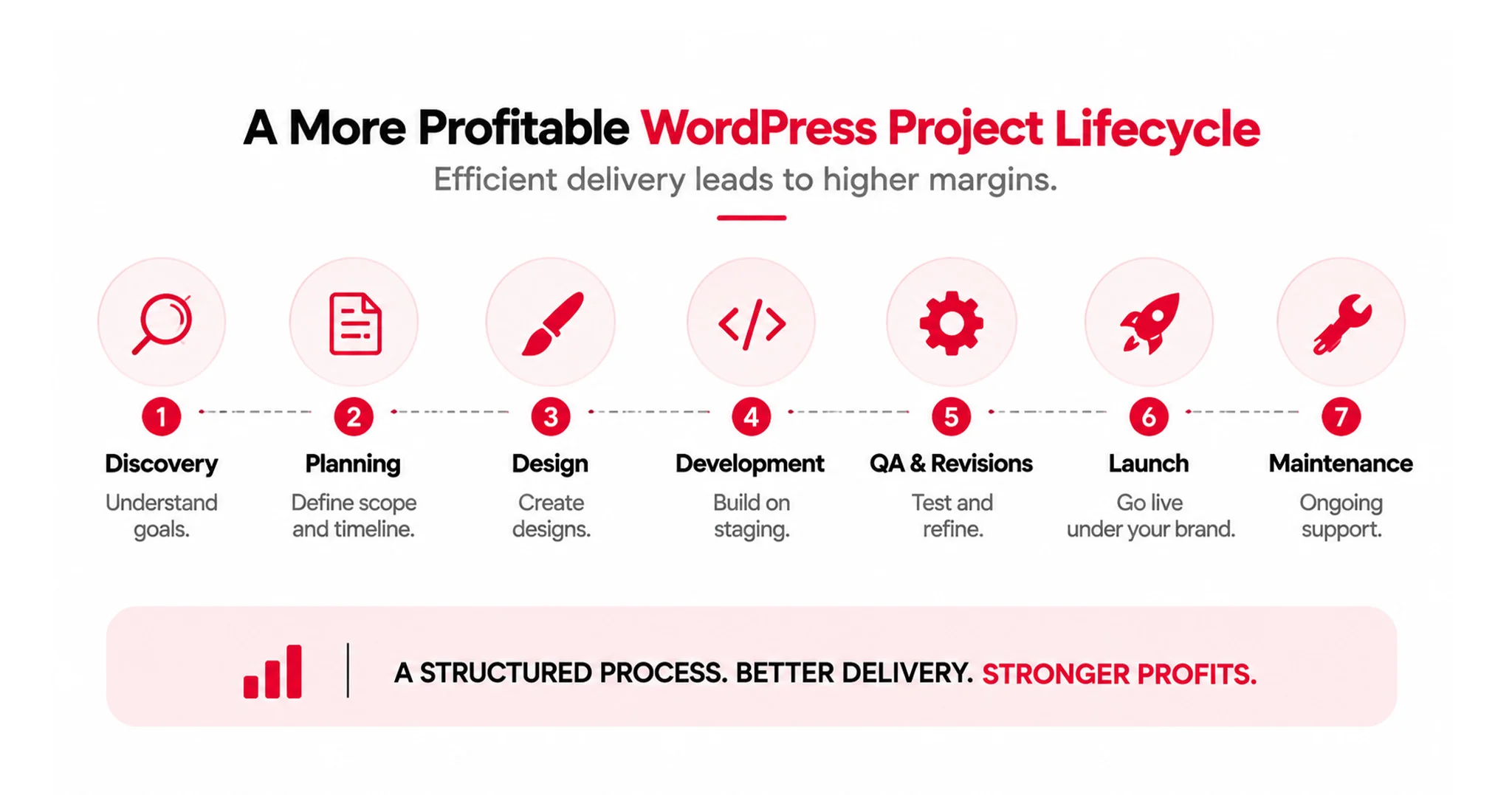
5 Ways to Boost profitability with White Label WordPress Development
Your WordPress profit margin is influenced by more than what you charge clients. Development cost, resource utilization, rework, project pricing, and delivery capacity can all determine how much revenue remains after completing the work.
White-label development can help agencies improve these areas when the delivery model is structured around profitability rather than simply reducing development costs.
1. Reduce Unnecessary Fixed Development Costs
Instead of maintaining a permanent development team for every possible workload, agencies can use external resources when project requirements exceed internal capacity. This may reduce costs associated with idle capacity, recruitment, employee benefits, and training.
However, agencies should also account for partner fees, project management, communication, revisions, quality assurance, and potential rework when calculating the true cost of external delivery.
Comparing the full delivery cost with available WordPress development solutions can help agencies determine which projects are suitable for external technical support.
Why It Is Important
Lower development costs create a larger gap between your client price and actual delivery expense, directly improving the margin available from each project.
2. Handle More Billable Work Without Expanding Permanent Payroll
An agency may have enough projects to generate strong revenue but still lack sufficient technical capacity during busy periods. External development resources can help absorb temporary increases in workload without requiring permanent hiring.
Flexible development capacity allows agencies to handle workload fluctuations without hiring permanent employees whenever project demand temporarily increases.
Why It Is Important
Better resource utilization means you can support more billable work without allowing payroll and fixed development expenses to increase at the same rate.
3. Reduce Rework That Eats Into Project Margins
Every additional development hour spent correcting avoidable errors reduces the profit originally expected from a project.
Clear requirements, experienced developers, structured reviews, and proper QA can reduce unnecessary revisions before work reaches the client.
Why It Is Important
Reducing rework protects the development hours included in your original estimate, helping you retain more of the revenue already generated by the project.
4. Price WordPress Projects Around Your Target Margin
Many agencies calculate project prices around development hours without considering the complete cost of delivery.
Management time, revisions, communication, quality assurance, and development expenses should all be considered before establishing the final client price.
Agencies should also account for ongoing WordPress maintenance and support when estimating the long-term cost of delivering and managing a website.
Why It Is Important
Understanding your true delivery cost makes it easier to set project prices that provide sufficient room for your desired profit rather than discovering margin problems after delivery.
Calculating a Target Project Margin
If an agency charges $5,000 for a WordPress website, its delivery costs might include:
| Cost Category | Example Cost |
|---|---|
| White-label development | $1,800 |
| Project management | $400 |
| QA and revisions | $300 |
| Client communication | $250 |
| Software and infrastructure | $150 |
| Total delivery cost | $2,900 |
The remaining $2,100 represents the gross contribution before broader agency overhead and taxes.
Agencies should calculate project profitability using the complete delivery cost rather than the development quotation alone. This includes internal management time, revisions, QA, communication, software, and support.
5. Scale Delivery Capacity Without Scaling Fixed Costs
Having larger WordPress projects can create profitability problems when agencies must immediately expand their permanent development team to fulfill new contracts.
A flexible delivery model allows agencies to increase technical capacity around confirmed opportunities while keeping their fixed cost structure relatively controlled.
Why It Is Important
You can pursue higher-value opportunities without automatically adding permanent payroll, creating a stronger path for profitable and sustainable agency growth.
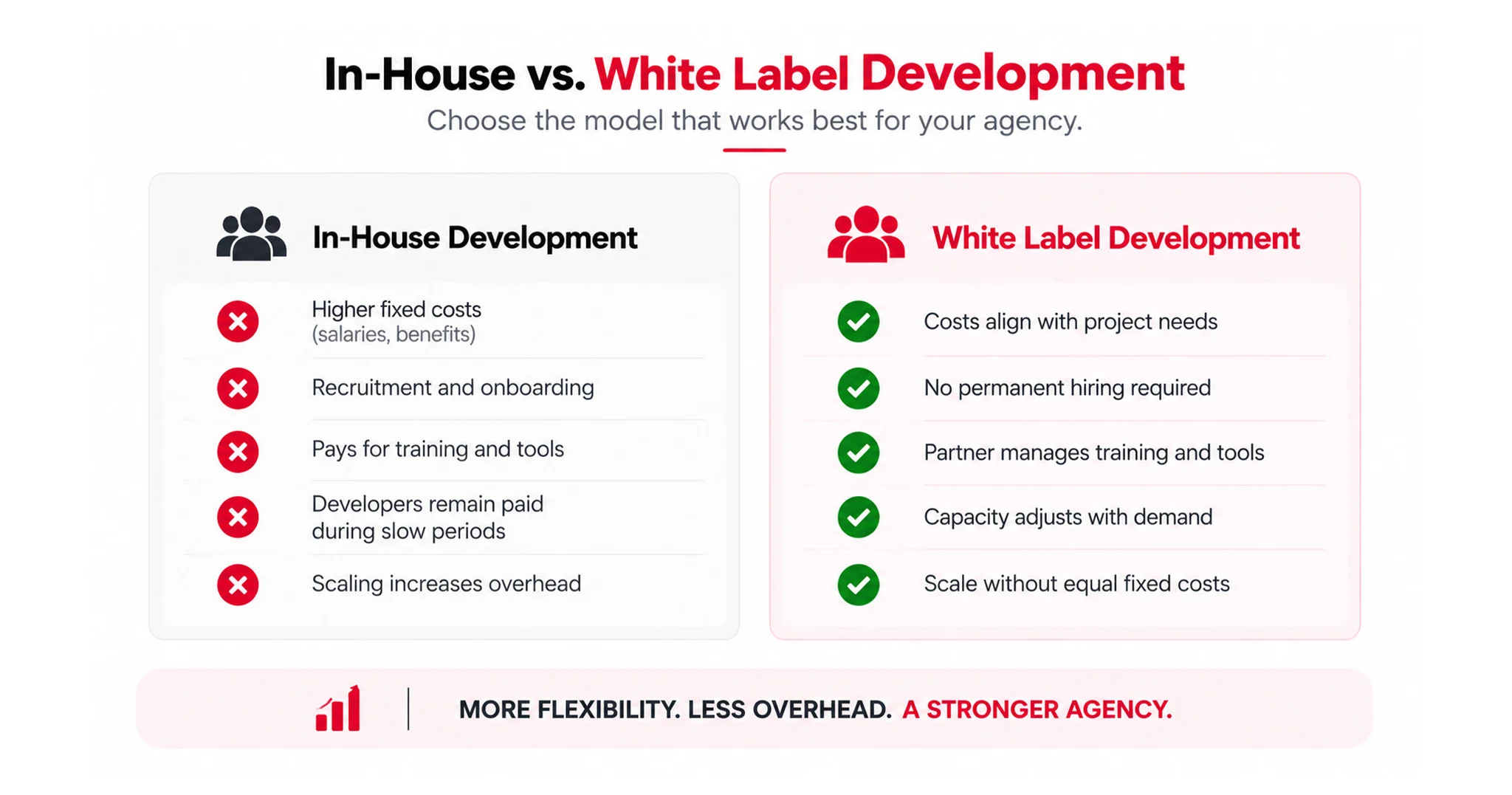
White Label vs. In-House WordPress Development: Which Is Better for profitability?
| Factor | In-House WordPress Team | White-Label WordPress Partner |
|---|---|---|
| Cost structure | Primarily fixed payroll and employment costs | Usually project-based or retainer-based |
| Recruitment | Requires hiring and onboarding | No immediate internal hiring required |
| Capacity | Limited to available internal resources | Can expand according to project demand |
| Slow periods | Agency continues carrying employee costs | External capacity can often be reduced |
| Technical control | Direct internal control | Shared through agreed processes |
| Project management | Managed internally | May include partner-side project management |
| Specialized skills | Requires internal hiring or training | Can access external expertise as needed |
| Quality assurance | Agency responsible for internal QA | Partner may provide dedicated QA processes |
| Best fit | Stable, predictable development demand | Variable or growing project demand |
There is no universal answer because profitability depends on project volume, technical complexity, employee utilization, management requirements, and long-term business objectives.
An internal team can provide greater direct control, while external development offers more flexibility when workloads fluctuate.
Agencies should therefore compare both models using their actual project economics instead of choosing based solely on salary figures or development quotations.
When an In-House WordPress Team Can Be More Profitable
An in-house team can be more profitable when development demand is stable, and the agency can consistently keep its technical resources productive.
- Consistent Workload: Permanent developers become easier to justify when the agency has a steady flow of WordPress projects throughout the year.
- Predictable Revenue: Stable project demand allows employee costs to remain closely connected with recurring development revenue.
- Internal Expertise: Developers become familiar with the agency's processes, client expectations, technical standards, and frequently used WordPress solutions.
- Faster Delivery: Familiarity with recurring project requirements can reduce communication time and improve development efficiency.
- Better Utilization: Agencies with consistently high developer utilization can potentially achieve stronger economics from an internal team.
When White-Label Development Can Improve Profitability
White-label development may support stronger profitability when agencies need flexible technical capacity without committing to permanent hiring.
The benefit depends on partner pricing, project quality, management requirements, and the agency’s ability to maintain appropriate client pricing.
- Fluctuating Demand: External resources can help agencies manage periods when project volumes increase or decrease unexpectedly.
- Specialized Skills: Agencies can access specific WordPress expertise without hiring permanent developers for skills they need only occasionally.
- Service Expansion: External development can help agencies introduce additional WordPress services without immediately increasing their internal workforce.
- Lower Hiring Pressure: Agencies can support new projects without committing to permanent payroll before future demand becomes predictable.
- Flexible Capacity: A white label WordPress agency can provide additional development resources while the agency retains control over client relationships, strategy, and positioning.
How Agencies Should Compare White-Label and In-House Costs
Agencies should compare:
- Average monthly development demand
- Average billable utilization
- Fully loaded employee cost
- White-label partner fees
- Internal project management hours
- Average rework and revision costs
- Recruitment and training expenses
- Expected workload during slow periods
- Required technical specialization
- Long-term ownership and control requirements
The relevant comparison is not salary versus outsourcing fees. It is the fully loaded cost of maintaining internal delivery capacity versus the total cost of external delivery.
How to Choose a White-Label WordPress Partner Without Losing Your Margins
Evaluate Development Quality Before Price
Low development pricing means little if every project requires significant internal supervision and repeated corrections.
Review previous WordPress work, technical capabilities, communication standards, development practices, and experience with projects comparable to your requirements.
Ask how the team handles custom functionality, responsive implementation, integrations, performance considerations, and technical troubleshooting before making a commercial decision.
Reliable quality can reduce hidden agency costs that are difficult to identify when providers are compared only through their quoted development prices.
Check the Development Partner's QA and Delivery Process
Quality assurance should happen before a project reaches your client rather than becoming your agency’s responsibility after delivery.
A reliable partner should have a defined testing process covering functionality, responsiveness, compatibility, usability, and common implementation issues.
Look for processes that include:
- Requirement review before development begins
- Internal testing before client delivery
- Responsive and browser compatibility checks
- Clear revision and issue-resolution procedures
- Defined communication and delivery milestones
A structured QA process reduces the number of issues your account managers, designers, and internal developers need to identify manually.
You should also understand how reworks, updates, and iterations are handled when requirements change or delivered work does not meet agreed specifications.
Ensure Pricing Supports Your Target Margin
A development partner should fit your financial model rather than forcing you to redesign project pricing after every engagement.
Calculate expected client revenue, development expenses, project management time, rework allowances, and desired profit before accepting the quoted delivery cost.
The right partner should leave sufficient room for your agency to manage the account profitably while maintaining a competitive client price.
Transparent pricing also makes it easier to create repeatable service packages and establish minimum project margins across different WordPress offerings.
How QeWebby Helps Agencies Build a More Profitable WordPress Delivery Model
QeWebby supports digital agencies with white-label WordPress development designed around flexible capacity, clear communication, and predictable delivery processes. Our goal is to help agencies expand their technical capabilities without taking on unnecessary permanent development overhead.
Flexible WordPress Development Capacity
QeWebby helps agencies access dependable WordPress development capacity without requiring them to build and maintain every technical resource internally.
Structured Technical Delivery
Agencies can extend their delivery capabilities for individual projects, recurring workloads, or periods when internal development resources are already fully committed.
Agency-Centered Communication
Agencies remain responsible for client relationships, communication, strategy, and overall project direction while QeWebby supports the technical execution.
Quality Assurance and Revisions
A flexible development structure can help agencies manage technical expenses according to actual project requirements instead of carrying excess permanent development overhead.
Scalable Partnership Models
QeWebby can function as an extension of an agency’s delivery team, helping businesses pursue additional opportunities while building a more scalable and profitable WordPress service model.
Conclusion
Strong agency margins depend on more than increasing project revenue. They require careful control of development costs, resource utilization, project scope, quality, and management time.
White-label WordPress development may help agencies increase technical capacity without immediately expanding permanent payroll. However, the model is most effective when partner costs, internal management, revisions, QA, and client pricing are evaluated together.
The right delivery structure depends on project volume, technical requirements, internal expertise, and long-term business objectives. Agencies should test potential partners through a clearly scoped project and evaluate quality, communication, documentation, and profitability before establishing an ongoing relationship.
If your agency is looking for flexible WordPress development capacity, QeWebby can help you explore a delivery model suited to your requirements.
adminqewe