










Table of Content

The way people search for information has changed significantly over the past few years. Instead of typing short keywords and browsing multiple websites, users increasingly ask complete questions and expect immediate, accurate answers powered by AI.
The discovery of information on online platforms by users is now accompanied by artificial intelligence (AI), and it’s changing how users discover information online. Instead of browsing multiple websites, users are increasingly receiving direct answers through AI-powered search results. Users are increasingly relying on conversational AI assistants and AI-powered search experiences such as Google’s AI Overviews, ChatGPT, Gemini, and Perplexity.
According to Gartner, traditional search engine volume is expected to decline by 25% by 2026 as users increasingly adopt AI assistants and generative search experiences. So, now businesses also need to optimize their strategies for search engines as well as AI systems.
These evolving shifts come as an opportunity and a challenge for WordPress websites. Before the AI overview, if your website was ranking and performing well in traditional search results, it didn’t guarantee a place in the AI overview. Why? Because the content of your website is lacking the structure, authority, and context AI systems rely on.
So, relying only on technical SEO improvements is not enough for improving your website’s AI search visibility. It has to be aligned with AEO and GEO rules, structure, and semantic optimization, along with high-quality content and SEO strategy.
Why Is AI Search Changing WordPress Visibility?
For that, you need to think from the user’s perspective. As a user, you would like to get the exact answer to your question, and not all users want to go through the entire information; they come with a specific question in their mind, and they ask for it.
Now, users don’t want to browse multiple websites or web pages related to their search; they want the exact information related to their search query.
AI search visibility for WordPress works in a different way. Now AI-powered search analyzes information from multiple trusted sources and generates fast, accurate responses.
Instead of prioritizing and ranking the content that simply contains the right keywords, AI systems prioritize information that demonstrates expertise, clarity, and relevance, influencing WordPress SEO service providers to adapt their optimization strategies.
According to a report, Google AI Mode reached 75 million users by December 2025, while revenue from its generative AI products increased by nearly 400%. The number itself showcases how AI-generated conversational search results are becoming users’ first choice over traditional search that relied on keywords only.
For WordPress websites, this changes how they increase their visibility, build a brand, and drive traffic.
Improving AI search visibility in WordPress requires creating content that both search engines and AI models can easily interpret, validate, and reference.
Businesses shouldn’t lose their opportunity to appear in AI searches, and it doesn’t mean that traditional SEO ranking is of lesser importance.
Appearing in AI-generated summaries, featured responses, and conversational search results helps you get more traffic, leads, authority building, and brand awareness. It’s not about AEO vs GEO vs SEO for WordPress websites, but it’s about how you can sync all of these.
Why Traditional SEO Alone Is No Longer Enough?
Traditional SEO continues to be an important foundation for online visibility. However, AI-powered search experiences evaluate content differently by considering context, expertise, and how well information answers user intent.
Businesses looking to improve AI search visibility on WordPress should view SEO, AEO, and GEO as complementary strategies rather than separate initiatives.
Modern AI systems evaluate how information is organized, whether it demonstrates topical expertise, and how confidently it can be cited when generating responses. This makes content quality, semantic relevance, and technical optimization just as important as keyword placement.
Traditional SEO and AI optimization work together through:
- Search Intent: Create content that answers complete user questions instead of targeting individual keywords.
- Content Depth: Cover topics comprehensively rather than publishing isolated articles.
- Technical Foundation: Maintain strong website performance, crawlability, and structured data.
- Authority Signals: Build topical expertise through consistent, high-quality content.
6 Strategies to Improve AI Search Visibility for WordPress Websites
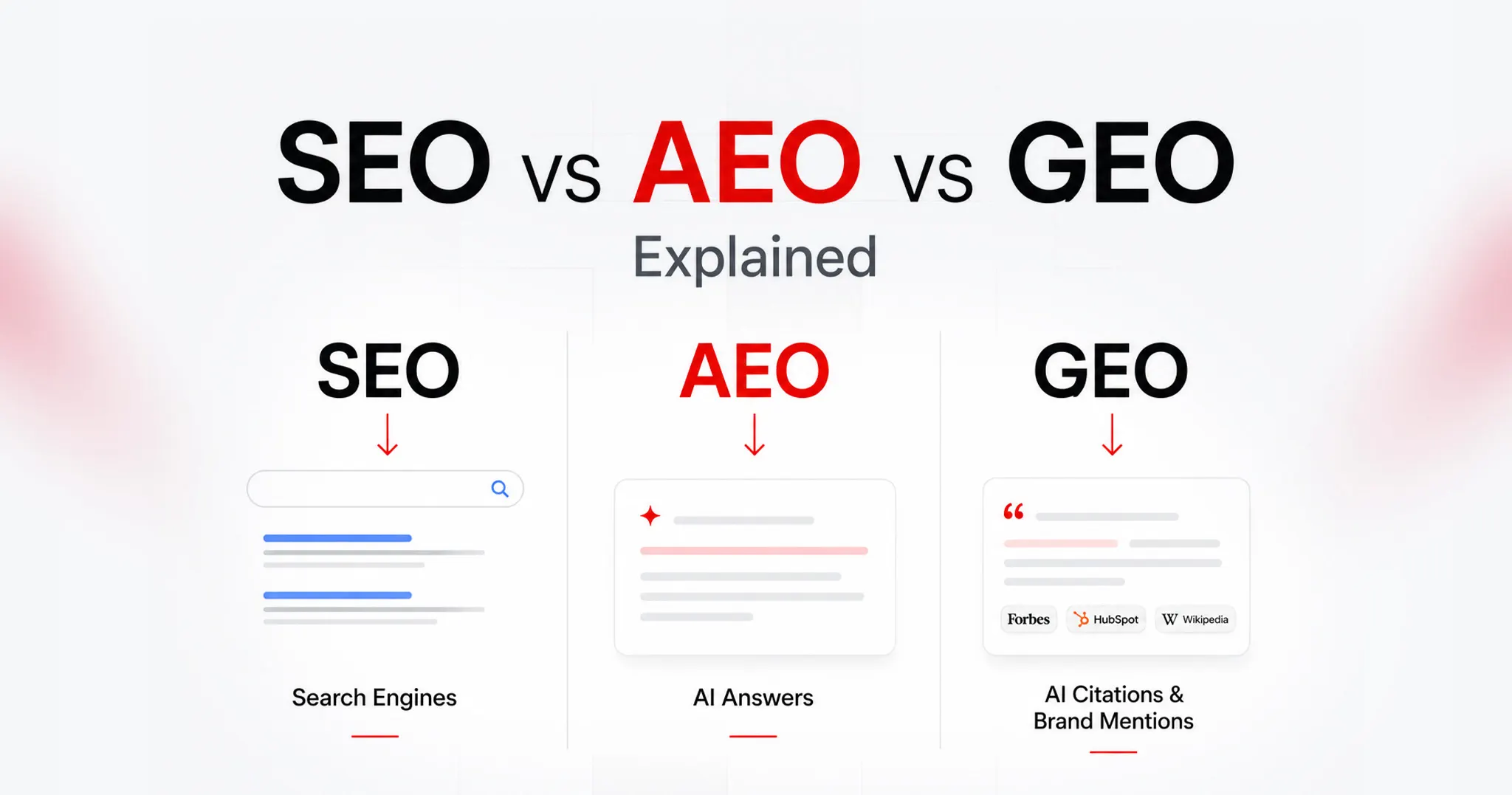
1. GEO vs AEO vs SEO WordPress
Understanding GEO vs AEO vs SEO in WordPress helps businesses build a strategy that supports both traditional search engines and AI-powered discovery platforms.
SEO focuses on improving visibility in search engine results. Answer Engine Optimization (AEO) helps content appear as direct answers to user questions, while Generative Engine Optimization (GEO) focuses on making content understandable and trustworthy enough for AI systems to reference when generating responses.
Rather than replacing SEO, GEO, and AEO, build upon them. Businesses that combine all three approaches create stronger visibility across both conventional search results and AI-powered experiences.
Together, these approaches create a more resilient search strategy across both traditional and AI-powered search.
What Steps Can WordPress Websites Take?
- Build content around user intent
- Answer questions clearly and directly
- Strengthen topical authority
- Combine SEO, AEO, and GEO strategies
Bonus Tip: Review your highest-performing blog and identify whether it answers customer questions directly or simply discusses the topic. AI systems often prioritize content that provides immediate, well-structured answers.
2. Create Content That AI Can Easily Understand
AI models process content differently from traditional search engines.
Instead of relying heavily on keyword repetition, they evaluate how clearly ideas are explained, how topics connect, and whether the content demonstrates expertise. Pages with logical headings, well-organized sections, and contextual relationships are easier for AI systems to interpret.
For businesses improving AI search visibility in WordPress, content structure becomes just as important as content quality. Articles should answer specific questions, explain concepts thoroughly, and maintain consistency throughout the page.
What Steps Can WordPress Websites Take?
- Use descriptive headings
- Organize content into logical sections
- Answer common customer questions
- Maintain a consistent content structure
3. Build Topical Authority Instead of Publishing Isolated Content
Client retention is the most direct indicator of service value in an agency business model. A clear retention gradient across service configurations: agencies delivering traditional SEO only report 72 to 78% retention, with the primary churn reason being clients citing a lack of AI visibility.
Agencies offering SEO with basic AI awareness report 82-87% retention. Agencies offering proactive, comprehensive AEO report the strongest retention performance in the cohort.
The mechanism behind that gradient is straightforward. Clients experiencing declining organic traffic are now aware that AI search behavior is a contributing factor.
An agency that can address that concern directly, with structured AEO deliverables and monthly reporting on AI citation rates, provides an evidence-based response to the question every client is beginning to ask. An agency that cannot address it creates an opening for a competitor that can.
The retention implication extends to renewal contract value. Clients who understand AI visibility as a measurable, improving outcome are more likely to authorize expanded scope and longer contract terms. This is not a marginal effect.
4. Competitive Differentiation in a Crowded Service Market
The differentiation value of AEO as a service offering is a function of supply, not demand. Demand is clear and growing. ChatGPT recorded 5.8 billion monthly visits in late 2025, with users sending 14 billion daily queries. Client awareness of these platforms as discovery channels is now mainstream.
Supply, however, remains constrained. Most regional and mid-size agencies lack the specialist expertise to execute AEO independently. The agencies that can credibly present AEO capability in a pitch, back it with a structured delivery methodology, and report against measurable AI visibility outcomes occupy a differentiated position that competitors without the capability cannot match on service grounds alone.
White-label delivery through a specialist partner like QeWebby provides the methodology, tooling, and delivery infrastructure that makes that credibility possible. The agency presents the capability. QeWebby executes it, invisibly, under the agency’s brand.
5. Operational Scalability Without Proportional Headcount Growth
The operational constraint that limits most agencies from launching new service lines is not a lack of capability. It is capacity. Adding a genuinely new technical service requires recruitment, training, process design, tooling acquisition, and quality assurance infrastructure before the first client deliverable can be produced. That sequence is time-consuming and operationally expensive.
White-label AEO removes that constraint from the equation. The fulfillment infrastructure, specialist team, tooling stack, and quality assurance process are part of the white-label partner’s operations. The agency adds AEO to its service portfolio and begins delivering it to clients without any of the internal scaling work that would otherwise precede the first engagement.
The scalability principle compounds. An agency that adds five AEO clients through a white-label model adds five retainer accounts without a corresponding increase in headcount, management overhead, or delivery risk. The same logic applies to ten, twenty, and beyond. QeWebby’s services infrastructure is built to absorb that scale, meaning the agency’s growth ceiling is not constrained by the white-label partner’s capacity.
6. Early-Mover Brand Positioning Before Market Saturation
Brand authority in a service category is built through consistent, visible execution before the category reaches saturation. Brands and agencies that establish entity authority before answer engines are saturated with optimized content accumulate more citations, which in turn build further authority. This dynamic rewards early movers with a compounding advantage that late entrants cannot replicate through volume alone.
The same dynamic applies at the agency level. An agency that is known in its market for AEO capability in 2026 is positioned differently from one that adds the service in 2028, when it has become a standard offering.
The former can speak to client outcomes, case evidence, and delivery methodology built over two years of active engagements. The latter is entering a commoditized market on the same footing as every other late adopter.
White-label delivery through QeWebby enables agencies to establish that positioning now, without the internal development timeline that building the capability independently would require. The brand authority belongs to the agency. QeWebby’s specialist team manages the execution infrastructure.
What White Label AEO Actually Delivers: The Engagement Structure
#1. AI Visibility Audit
Every engagement begins with a baseline audit. This establishes which queries in the client’s category currently trigger AI-generated answers across ChatGPT, Perplexity, Google AI Overviews, and Bing Copilot; whether the client brand appears in any of those answers; which competitors are being cited; and where structural content gaps prevent citation.
The audit output is branded to the agency and presented to the client as the evidence base for the engagement scope.
#2. Answer-First Content Restructuring
AI systems do not read full articles. They extract the first one to two sentences of each H2 or H3 section. Answer-first restructuring rewrites section openings so they lead with a direct, extractable answer. It adds definition blocks in the 40- to 60-word format that trigger featured snippet eligibility.
It introduces the FAQ schema for question-based content and the HowTo schema for process content. On a WordPress site, this restructuring integrates directly into existing page architecture without requiring a full content rebuild.
#3. Schema Markup Implementation
FAQ schema, Article schema, and HowTo schema form the machine-readable layer that signals content structure to AI crawlers. Without a structured schema, well-optimized content may not be correctly parsed by the AI systems that depend on structured signals to identify extractable answers.
Schema implementation is a technical deliverable that sits squarely within WordPress development competency, making it a natural complement to existing wordpress seo optimization service operations.
#4. Entity Authority Building
AI systems associate brands and practitioners with specific topic areas through entity relationships built from third-party citations, knowledge graph data, and cross-platform mentions.
Entity authority building creates and reinforces those associations: securing citations from sources that AI systems assign high trust weighting, building topical associations with the right industry entities, and ensuring the client’s knowledge graph profile is accurate and comprehensive.
This is the GEO layer of AEO work. It compounds over time and creates durable AI visibility that is significantly harder for a competitor to replicate than a schema update or content restructure.
#5. AI Visibility Monitoring and Reporting
Monthly reporting tracks featured snippet wins, PAA appearances, and brand citation rates across all major AI platforms.
This is the retainer-justification layer. Clients who receive a monthly report showing their AI visibility score improving quarter over quarter do not cancel.
The reporting cadence also provides the agency with a consistent touchpoint to discuss expanded scope, additional pages for restructuring, and new query categories as the client’s visibility footprint grows.
Is Your Agency Positioned to Add AEO? A Practical Readiness Assessment
- Existing retainer clients have asked about AI search visibility or have questioned why their brand does not appear in AI-generated responses.
- A client mentioned ChatGPT, Perplexity, or Google AI Overviews by name in a retainer review conversation in the past six months.
- Retainer renewal conversations require more justification than they did 12 to 18 months ago, and declining organic click-through rates are part of that conversation.
- The agency currently delivers wordpress seo optimization services and is positioned to add a complementary AI visibility layer to existing engagements.
- New business pitches require a differentiation narrative that goes beyond keyword rankings, traffic volume, and content production capacity.
- The agency wants to expand the addressable contract value per client without the recruitment and onboarding timeline required to build a new internal service line.
If two or more of these apply, the commercial and operational rationale for white-label AEO is already present in your client base. The question is not whether to offer AI visibility services. It is whether your agency is positioned to offer them before the competitive window narrows.
Final Thoughts
White-label AEO is not a short-term revenue play. It is a structural response to a permanent shift in how consumers and B2B decision-makers discover, evaluate, and engage with brands. The agencies that build AEO capability into their service portfolio now, through white-label delivery or otherwise, are establishing a defensible position before the capability becomes a commodity.
The white-label model accelerates that positioning. It removes the internal development timeline. It provides immediate access to specialist tooling and methodology.
This allows agencies to compete on capability from the first client conversation, without waiting for an internal team to reach production readiness. Our white-label AEO services operate on exactly that model: your brand, your client relationship, QeWebby’s execution.
The search landscape your clients operate in has changed. The agencies that acknowledge that change and act on it now will be the ones leading retainer renewal conversations in 2027 from a position of demonstrated capability.
adminqewe
Frequently Asked Questions
#1. What Is An Answer Engine Optimization Agency?
An answer engine optimization agency specializes in structuring client content so that AI platforms, including ChatGPT, Perplexity, Google AI Overviews, and Bing Copilot, cite it in their generated responses.
Unlike traditional SEO agencies, which optimize for blue-link rankings, an AEO agency targets the AI-generated answer layer that now precedes organic results for a growing share of search queries. For a practical introduction to our AEO services, visit the services page.
#2. How Does White-Label AEO Differ From White-Label SEO?
White label SEO covers keyword research, on-page optimization, link building, and technical site health within the traditional Google and Bing ranking ecosystem. White-label AEO addresses a distinct set of optimization layers: schema markup for AI extraction, answer-first content structure, entity authority building across knowledge graphs, and visibility monitoring across AI platforms.
The two services are complementary and are most effective when delivered together as part of a unified search visibility program.
#3. How Does White-Label AEO Integrate With Existing WordPress SEO Optimization Services?
AEO integrates directly into the WordPress site architecture. Schema markup is implemented via existing SEO plugins or direct code. Answer-first content restructuring is applied to existing pages without a full content rebuild. Reporting is layered into existing client dashboards.
For agencies already delivering WordPress SEO optimization services through QeWebby, AEO operates as an extension of the existing white-label engagement rather than as a separate program.
#4. What Operational Changes Does An Agency Need To Make To Offer White-Label AEO?
Minimal. The white-label model is designed to integrate into existing agency operations without requiring structural changes to delivery processes, account management, or client communication.
The agency briefs the engagement scope, presents deliverables under its own brand, and manages the client relationship as it does today. QeWebby handles specialist execution entirely behind the scenes. Review the QeWebby agency partner program for the full onboarding process.
#5. Which AI platforms does White-Label AEO cover?
#6. How Quickly Can An Agency Begin Delivering AEO Services To Clients?
Agencies partnering with QeWebby can onboard their first white-label AEO client within one to two weeks of initiating the partnership. The initial AI visibility audit for a new client requires five to seven business days.
Monthly retainer deliverables operate on a recurring production cycle managed entirely by QeWebby. No internal AEO training, recruitment, or tooling investment is required on the agency side.