















Someone hires a WordPress developer. Three months later, the site still isn’t live. Feature velocity stalls. Technical debt piles up until delivery grinds down. The paycheck clears every two weeks. The launch date keeps sliding. The business ends up worse off than when it started.
Nobody likes admitting how often this happens. Especially in the “velocity-first” trap: teams that look fast out of the gate, then stall once they hit a codebase they never understood.
That’s why most companies get outsourcing wrong. They treat it like a coupon to dodge a salary line, nothing more. That framing skips the mechanics that decide whether a project ships or turns into a slow bleed of lost rankings and drained ad income.
Hiring in-house is expensive. Offshore development often costs less. Everyone knows that part. What rarely makes the pitch is the engagement model. How the work’s structured matters more than where the developer sits. Someone embedded in your process, who understands the codebase before touching it, tends to succeed.
This guide covers both the cost savings everyone expects and the operational advantages that usually become obvious after a few months. Protecting your revenue through deployment discipline. Keeping full ownership of your assets and credentials.
What Outsourcing WordPress Development Actually Means in Practice
In practice, outsourcing WordPress development means handing site builds, customizations, and maintenance to outside specialists who bring operational elasticity and technical chops you don’t have to build in-house. It’s not one transaction. It’s a spectrum: bounded freelance tasks on one end, dedicated offshore engineers sitting inside your Slack and Jira on the other.
1. The Three Primary Engagement Models
The structure you pick determines the risk you’re carrying, not the other way around.
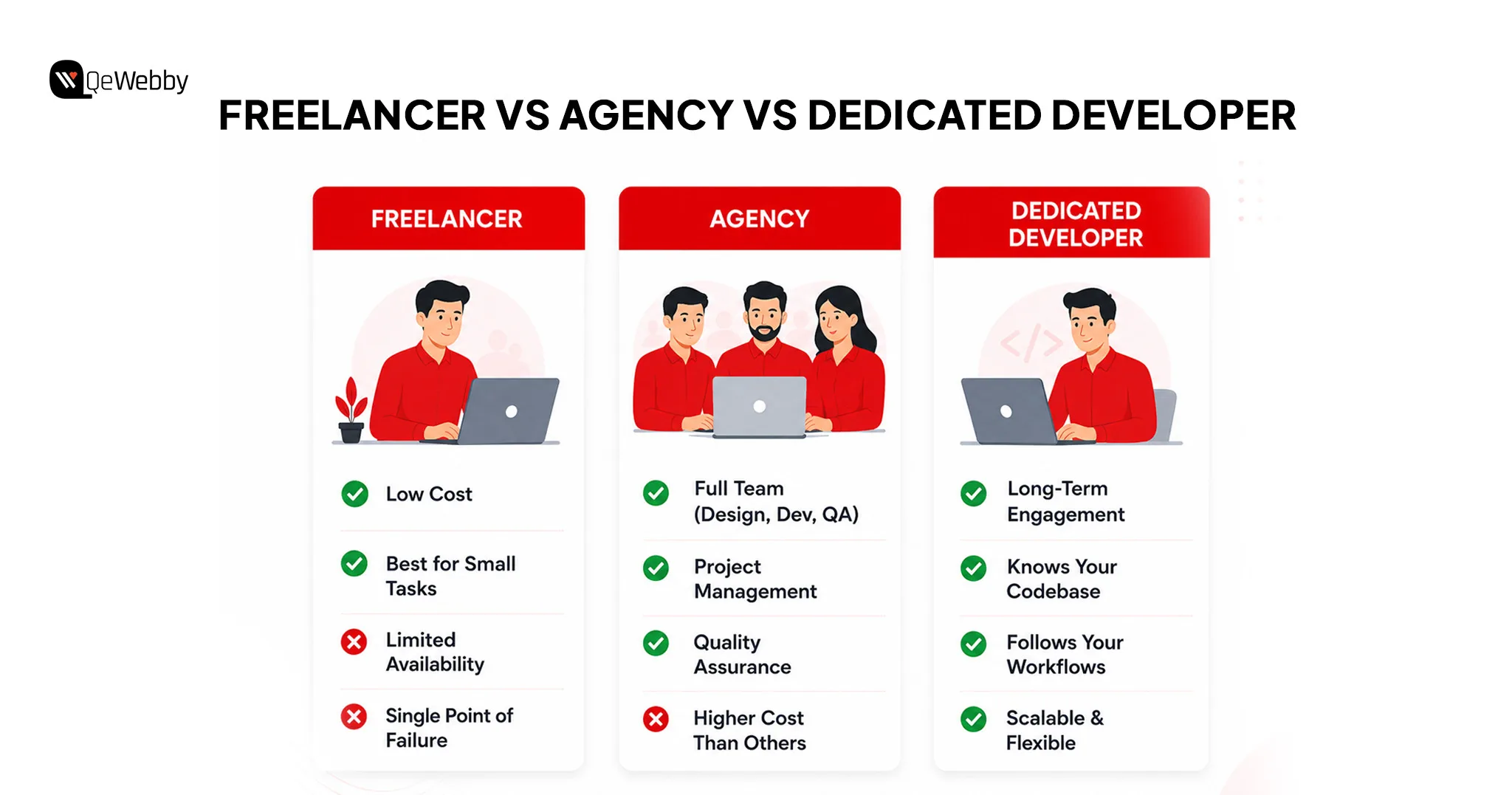
- Freelancers (Task-Based): Good for a bounded fix with a clear finish line. Cheap, sure. But the “bus factor” is real. One person disappears, and the project stalls.
- Agencies (Project-Based): Makes sense for multi-discipline builds (design, dev, QA) under a tight deadline. You’re paying for someone else to absorb the coordination overhead. That shows up in the blended rate.
- Dedicated Offshore Developers (Integrated): Where most SMBs and agencies land for ongoing work. The developer works exclusively for you, learns your codebase, workflows, and engineering standards. This is the model that actually holds up over time, unlike distant vendors working strictly off a ticket queue with zero context.
2. Operational Elasticity and the “Follow-the-Sun” Model
Scale up for a launch. Scale down once things settle. No long-term hire to unwind when the busy season ends.
In practice, this usually runs on a follow-the-sun loop. Internal teams hand off tasks at the end of their day. Offshore teams in India, Southeast Asia, or Eastern Europe pick up the work overnight. By morning, it’s sitting there ready for testing. Your development cycle effectively continues around the clock.
3. The “Revenue Firewall”: Deployment Discipline
At scale, outsourcing stops being about “just building” and becomes about enforced deployment controls. Here’s why that matters: a bad deploy on a high-traffic site isn’t a support ticket. It’s a revenue event. Ad income and search rankings can take a hit within hours, not weeks.
- Deployment Constraints: Serious partners work inside strict pipelines (the kind WordPress VIP mandates), which means pre-production code review and continuous performance monitoring, not a quick push and a prayer.
- SEO as Engineering: Treated as a technical deliverable. Commits get checked against structured data and Core Web Vitals before they ship, not after something breaks.
4. Architectural Optimization (The “Plugin Diet”)
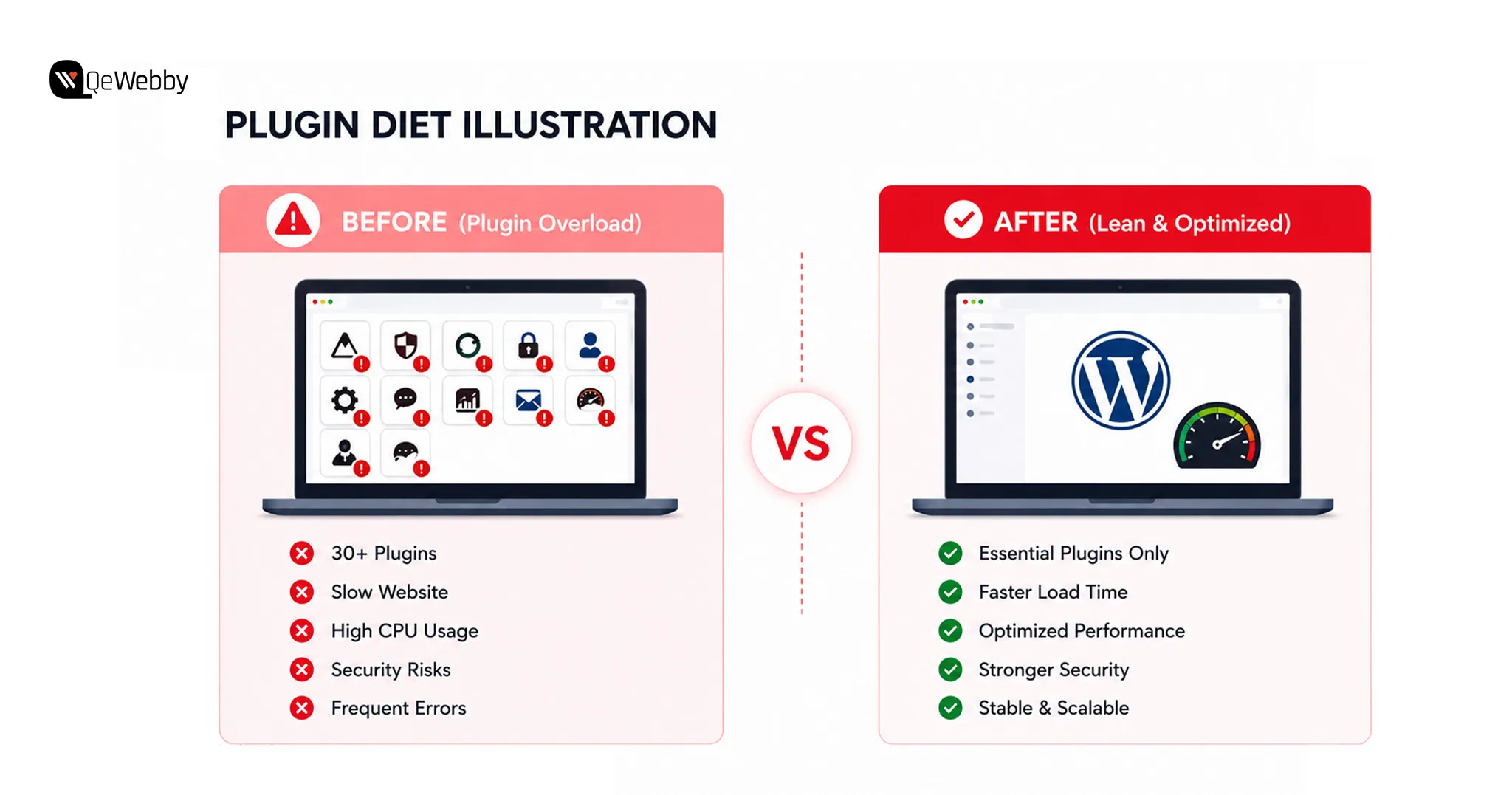
Professional outsourcing tends to strip out technical debt and plugin bloat. Amateur builds lean on heavy plugins for features that barely matter, chewing through CPU and PHP resources they don’t need to.
Experienced developers move that weight off the WordPress application layer entirely. Security firewalls, image optimization, caching: pushed to the server or edge network instead. The site ends up leaner. Faster. More stable.
5. What Must Remain In-House
Even in a fully outsourced setup, a few things stay close to home.
- Site Strategy: Hosting stack decisions, architectural direction, which plugins actually carry weight in the build.
- Asset Ownership: Full ownership of source code, hosting panel, domain registrar, DNS. No exceptions.
- Brand Voice: Content direction and messaging hierarchy stay internal. Nobody outside the business should be deciding how it sounds.
The Expected Benefits (That Everyone Already Knows)
It Costs Less Than an In-House Developer
Hiring in-house starts weeks before anyone writes code. Scope the role. Build the application process. Post it. Screen resumes. Interview. Onboard. None of that ships a single feature. And that’s before salary, benefits, and overhead even show up on the spreadsheet.
Outsourcing skips all of it. The business pays for work when it needs the work, not a fixed headcount sitting there during a slow quarter.
Is it cheaper for defined-timeline projects specifically? Almost always, yes, because benefits, office space, and equipment costs disappear entirely. That’s the structural reason the savings number from the intro holds up whether the business has five employees or five hundred.
It Gives Instant Access to Specialists
Outsourcing puts a business in front of a global bench of developers who’ve already solved the exact WordPress problem the business is hitting for the first time. Custom themes, advanced functionality, the stuff an internal generalist genuinely cannot pull off no matter how sharp they are.
One in-house hire usually knows a bit of everything. Outsourcing flips that. Now it’s specialists who do one narrow thing extremely well, every day, across dozens of client sites.
Top 6 Unexpected Benefits Nobody Talks About Until After They Try It
The following, however, is what comes on the calendar after three months of planning for the outsourcing arrangement, and it’s really why companies that attempt outsourcing hardly ever come crawling back to the traditional approach.
Unexpected Benefit 1: The In-House Team Suddenly Achieves More
Few businesses realize this before they outsource. When the company sets up its own WordPress team, all the technical problems become everyone’s problem. A malfunctioning plug-in isn’t just a headache for the developer.
It’s also a problem for the marketing manager who needs a page launched right now, the founder dragged into a Slack channel against their will, and the sales team watching helplessly as the promised landing page fails to launch.
Move development outside the building, and the marketing team markets. Sales sells. The founder actually gets to think about strategy instead of getting looped into a debugging session over a plugin conflict nobody understands.
Outsourcing web development buys agility, and it lets a business scale operations without adding headcount. Internal attention stays locked on the work only internal people can do, while the outside team handles execution.
Unexpected Benefit 2: Development Happens While the Business Sleeps
Offshore teams often sit in a completely different time zone. By the time the internal crew logs on, a full development cycle has usually already happened overnight.
That gap isn’t a scheduling headache to work around. Used right, it means development and support run around the clock instead of going quiet at 6pm.
For anything deadline-driven, or an urgent fix that can’t wait until Monday, that overlap is a genuine edge. No single-time-zone in-house team, however good, can match it.
Unexpected Benefit 3: The Site Gets Built Faster Than Any Internal Team Could Manage
Outsourced agencies start immediately. The team already exists. Compare that to hiring in-house, where finding one qualified WordPress developer can eat most of a two-month project window before a single line gets written.
Experienced outsourced teams have already shipped dozens, sometimes hundreds, of WordPress projects. They show up with workflows, starter templates, and processes that have already absorbed the trial and error that slows down a first-time internal build.
Four months for an internal team. Six to ten weeks for a specialized outsourced one, doing the same job. Not because anyone’s cutting corners. Because the team has run this playbook enough times to know exactly where the delays hide.
Unexpected Benefit 4: Built-In Quality Control the Business Does Not Have to Manage
Professional outsourced agencies bring their own QA process, code review, and testing protocol to every project by default. Quality stops being something a business owner has to invent from scratch.
That means functionality tests, cross-browser checks, security audits, and performance passes, all measured against actual WordPress coding standards, not just whatever the last developer happened to know.
Something breaks after launch? A reputable agency fixes it. Not the business owner, alone, on a laptop at 11 pm trying to remember which plugin update caused the mess.
Unexpected Benefit 5: Scale Up or Down Without a Single HR Conversation
Outsourcing lets a business dial development effort up or down based on actual demand, no long-term contract required. For anything with seasonal swings or a sudden growth spurt, that’s hard to overstate.
One month the business needs a full team for a major launch. Next month, just routine maintenance. Outsourcing absorbs both without redundancy costs or an uncomfortable conversation about cutting hours.
This matters most for agencies juggling several client projects on unpredictable timelines, where a fixed in-house headcount either sits idle or gets buried depending on the week.
Unexpected Benefit 6: The Business Gains a Security Advantage It Did Not Budget For
WordPress gets targeted constantly, simply because it runs so much of the web. Bring in a team with dedicated security chops, and proactive measures against data breaches and unauthorized access come standard, not bolted on afterward.
Only 22% of companies handling WordPress security in-house actually have a documented breach response plan. Outsourced agencies that specialize in this tend to be better equipped by default. Security is the job, not a side task someone’s developer squeezes in between features.
Ongoing outsourced maintenance means plugin updates happen on schedule, vulnerabilities get patched before bots find them, and backups actually get verified instead of just assumed to be running somewhere in the background.
First-time outsourcers often start small, a single contained project through a WordPress development service, instead of jumping straight into a long-term commitment. Low risk, and it lets the business judge code quality, communication speed, and delivery discipline before scaling anything. For what a site needs before it even gets to this stage, see our breakdown of must-have WordPress features for a client website.
Outsourcing vs In-House: The Honest Comparison Nobody Wants to Do
What the Real Numbers Look Like Side by Side
| Factor | In-House Developer | Outsourced Team |
|---|---|---|
| Monthly cost | $3,831 to $7,045 | $500 to $3,000 depending on scope |
| Time to start | 4 to 12 weeks to hire | 1 to 5 days to onboard |
| Skill range | One person’s knowledge | Full team of specialists |
| Scalability | Fixed headcount | Flexible up or down instantly |
| Quality control | Business manages it | Agency manages it |
| Time zone coverage | Business hours only | 24-hour development possible |
| Risk | Business owns all of it | Shared via contract and SLA |
When In-House Still Makes More Sense
Outsourcing isn’t right for every business. Pretending otherwise helps nobody. In-house tends to win when:
- The product IS the WordPress site, as with a SaaS platform where development is the core business activity rather than a supporting function
- Daily work requires deep knowledge of internal proprietary systems an external team cannot realistically access
- The business has already built a strong internal development culture worth preserving
- The budget comfortably supports a full-time senior developer and their long-term retention without strain
The Hybrid That Most Growing Businesses Land On
Most companies don’t end up fully in-house or fully outsourced. They land somewhere in between: one internal developer or technical lead owns strategy, requirements, and review, and an outsourced team handles execution.
That setup gives the business control without the full overhead, plus specialist skills on demand without paying for them year-round. Leverage expertise from wherever it happens to sit, deliver strong results to clients, and keep internal focus exactly where it belongs, on what only the internal team can actually do.
How to Outsource WordPress Development Without Getting Burned?
Here are some of the key steps that you can follow to ensure efficient outsourcing of WordPress development.
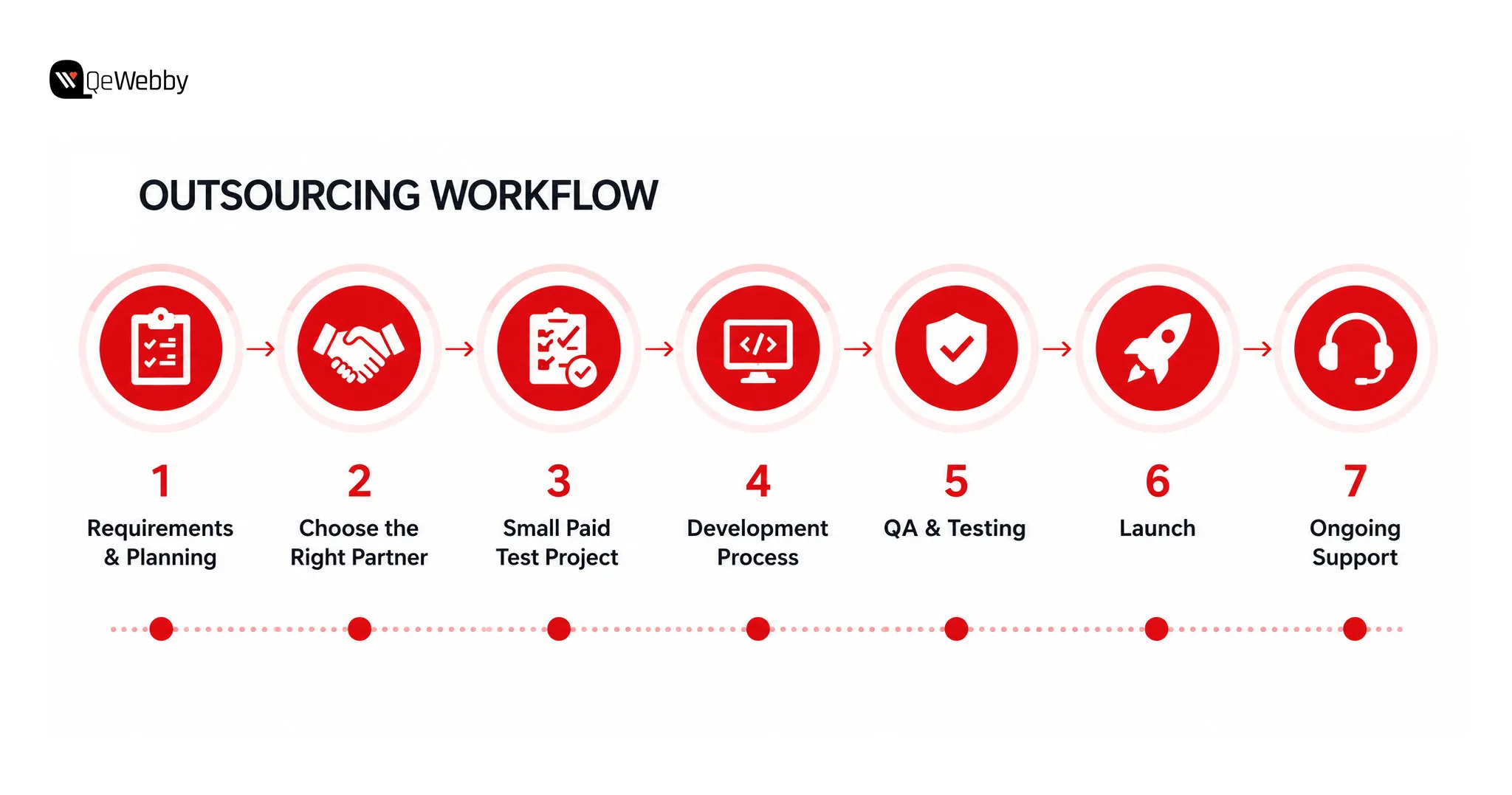
Define Exactly What Is Needed Before Talking to Anyone
The most common outsourcing mistake happens before the first vendor call. Businesses start pricing conversations before they actually know what the project requires.
Write a one-page brief. Project goal, pages or features needed, a realistic budget range, timeline, and any technical requirements tied to existing systems. A clear brief gets an accurate quote. A vague one gets an inflated quote padded with contingency buffers to cover everything the vendor can’t predict.
Evaluate Agencies on the Right Things
Look for a WordPress-specific portfolio, verifiable client reviews, a QA process they can actually explain, and a documented post-launch support policy.
Read the reviews. Check the case studies. Strong testimonials, especially from other agencies rather than anonymous reviewers, are a decent signal the provider hits deadlines and communicates clearly under pressure.
Ask for two or three references before signing anything. Then actually call them. Most businesses skip this step. Most of them regret it exactly once.
Start With a Paid Test Before Committing to a Long Engagement
Send a small, clearly scoped paid task before signing anything long-term. It reveals quality and communication style faster than any portfolio review or interview ever will.
For agencies specifically, ask for examples of past agency partnerships. A reliable WordPress provider follows documented coding standards and runs a clear QA process without needing to be asked twice.
Use milestone-based payments tied to specific deliverables. Never pay the full project cost upfront, no matter how confident the agency sounds on the sales call.
Agencies that resell WordPress development work to their own clients often lean on a white-label WordPress development service to make the model work. The outsourced team builds under the agency’s brand, the agency delivers to its client, and the end client never learns a third party touched the project. It’s how small agencies take on bigger, more numerous clients without hiring full-time staff they can’t yet justify.
The Question Every Business Asks Before Outsourcing: “What If It Goes Wrong?”
Most outsourcing articles stay relentlessly upbeat and skip the part sitting behind every business owner’s hesitation: what actually happens when it goes sideways. That deserves a straight answer, not another list of upsides.
The Real Risks of Outsourcing WordPress Development
- Poor quality code that is difficult to maintain or hand over to a different developer later
- Communication breakdowns that cause delays and missed deadlines
- IP and data security concerns tied to sharing hosting credentials and content access with an outside team
- Dependence on a single organization, where the project comes to a halt the instant the organization goes silent
- Hidden expenses due to scope creep, additional revision costs, or regular fees which were never made clear at the beginning
How to Safeguard the Business While Outsourcing?
Put down everything into an agreement including deliverables, deadlines, revision cycles, code ownership, and post-launch support policies in black and white. No exceptions.
Develop in a staging environment and never give outsourced developers access to the live site until they have proved themselves on a different project first.
Ensure that it is clearly stated in the agreement that the business holds 100% ownership of the code and assets provided
Green Flags That Tell the Business an Agency Can Be Trusted
- They ask detailed questions about the project before quoting, not the other way around
- They can explain their QA and testing process clearly without being asked
- They provide a written contract without the business needing to request one
- Communication is fast, professional, and specific from the very first interaction
- They have verifiable client reviews on third-party platforms like Clutch, Google, or Upwork, not just testimonials sitting on their own website
Before signing with anyone, it’s worth running through our WordPress security checklist, so the business knows exactly what to ask a prospective vendor about their security practices.
Outsourcing WordPress Development Is Not a Cost Decision. It Is a Growth Decision.
The businesses that outsource WordPress development and never look back aren’t doing it because they ran out of budget for an internal hire. They’re doing it because they figured out the internal team’s time is worth more than any WordPress problem.
However, the question was never really whether outsourcing costs less. It does. What matters more is what the business does with the time and budget it just got back.
Write down every WordPress task that ate up internal time last month. That list is exactly what an outsourced team should be handling, and exactly what the internal team should never have been doing in the first place. If the list runs long, a conversation with a WordPress development service is worth having before next month looks identical.
Still deciding between a dedicated freelancer and a full outsourced team?
Our comparison of dedicated vs extended team WordPress breaks down which structure fits which stage of growth, and pairs with any new build.